<?xml version="1.0" encoding="UTF-8"?>
<feed xmlns="http://www.w3.org/2005/Atom">
  <title type="text">Harrisburg Historical</title>
  <updated>2026-09-01T20:23:50+00:00</updated>
  <generator uri="http://framework.zend.com" version="1.12.20">Zend_Feed_Writer</generator>
  <link rel="alternate" type="text/html" href="https://harrisburghistorical.org/"/>
  <link rel="self" type="application/atom+xml" href="https://harrisburghistorical.org/items/browse?output=rss2"/>
  <id>https://harrisburghistorical.org/</id>
  <author>
    <name>Harrisburg Historical</name>
    <uri>https://harrisburghistorical.org</uri>
  </author>
  <link rel="hub" href="https://pubsubhubbub.appspot.com/"/>
  <entry>
    <title type="html"><![CDATA[Sister Mary Clare Grace and the St. Clare Infirmary: A Story of Care and Compassion in Harrisburg&#039;s Eighth Ward]]></title>
    <summary type="html"><![CDATA[<p><strong><em>After Sister Mary Clare Grace arrived in Harrisburg in 1869, she overcame anti-Catholic prejudice to become known as a woman of great service in her community. Among her many accomplishments was the establishment of an infirmary that treated troops during the Spanish-American War.</em></strong></p><img src="https://harrisburghistorical.org/files/fullsize/fc46f64c38ae11e19fb51f9f24444ec5.jpg" alt="Mother Mary Clare Grace" /><br/><p>On September 1, 1869, six sisters from the Convent of Mercy in Chicago arrived in Harrisburg. Their mission was to help the founder of the Harrisburg Diocese, Bishop Jeremiah Shanahan, strengthen the Catholic presence within the city. There was no convent available for them upon their arrival, so the sisters stayed at the residence of Reverend Shanahan at 214 State Street.Shanahan detailed that the labor the sisters would do would be difficult and strenuous; however, he felt that their passion for service would overcome such hardships. 
The sisters arrived with the understanding that they could return to Chicago if their work in Harrisburg proved undesirable. Within a year, two sisters departed for Chicago, while a third left the community altogether, returning to life as a layperson. This left three sisters, including Sister Mary Clare Grace, as the only remaining members in Harrisburg. Sister Grace was soon appointed as Superior by Mother Scholastica, the Mother Superior of St. Xavier’s Convent in Chicago, who believed that God had appointed Sister Mary Clare Grace to this position.
Sister Mary Clare Grace was born Mary Ellen Grace in County Waterford, Ireland, in 1833 into a devout and prosperous family. Her father, Thomas Grace, was the nephew of Thomas L. Grace, Archbishop of St. Paul’s Church in Dublin. Despite her wealthy upbringing, Mother Clare dedicated herself to a life of holy poverty, seeking to embody the example of Jesus Christ. Before moving to Harrisburg, she taught as a sister at St. Xavier Academy, a private school in Chicago for nine years. After being appointed by Mother Scholastica as Superior of the Harrisburg Foundation, she devoted herself to training aspiring young women and girls to become Catholic nuns.
During her time at the Harrisburg Foundation, Mother Clare was known for her deep humility and compassion, as well as her strict religious discipline. Some women chafed at her strong expectations and left the Harrisburg Foundation program. As one of the Sisters’ later biographers noted, “To many, Mother Clare seemed too rigid, too severe in the enforcement of religious discipline…many aspirants who entered the program did not remain.” Those who stayed “entered for the sole purpose of seeking their own perfection to make themselves worthy instruments of God.” Mother Clare was uncompromising in her belief that a holy life should include strict discipline, humility, selflessness, and a service to one’s community.
Her strict religious stance also made her a successful institutional leader. She established and led institutions such as St. Genevieve’s Academy on McClay Street, which was known as the Motherhouse and a main revenue source of the diocese. Here, she worked closely with Very Reverend John Vincent O’Reilly to set up a boarding school for women that would educate in religion and the arts. She also founded the Mercy Home residence on the corner of Second and Liberty streets, which provided low-income housing to girls and women. Next, she spearheaded the Sylvan Heights Orphanage on the corner of Twelfth and Derry streets to serve as an orphanage for girls from infancy to age seventeen. 
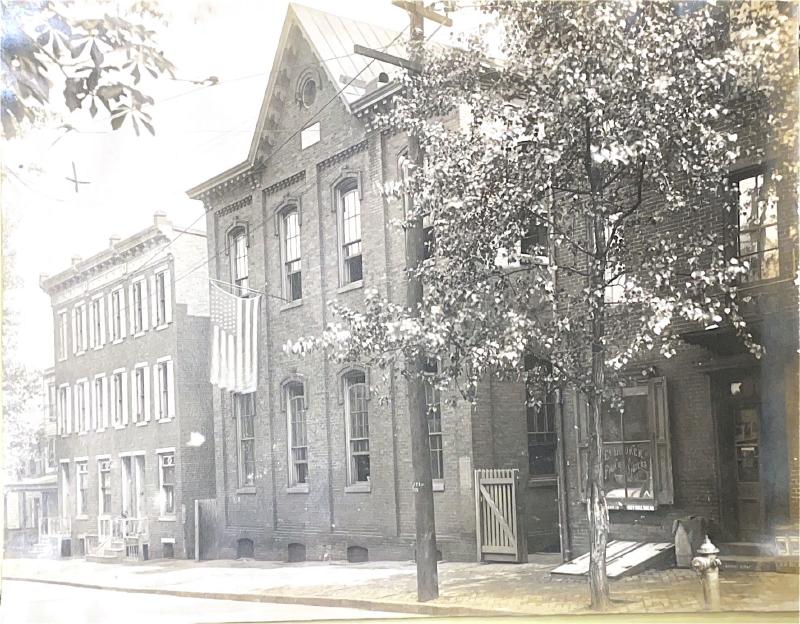
A central building used by Mother Clare and the Sisters of Mercy was the James Russ House, located at the corner of North and Fourth Streets. The largest mansion in the Eighth Ward, the James Russ House contained the Keeley Institute, which was known at the time for its pioneering treatment for alcohol addiction and drug use, serving as a place for patients to receive care during their recovery. The Keeley Institute operated in the James Russ House from 1892 to 1896 and again from 1901 to around 1908. After the Keeley Institute temporarily relocated to a property at the corner of North and Capitol streets, the Russ House served as St. Clare’s Infirmary. Founded in 1897, the Infirmary provided medical care, particularly to soldiers during the Spanish-American War, and was highly regarded by the local community. 
The layout of the infirmary included the kitchen, refectory, and offices on the first floor, while the second and third floors contained twelve private rooms and an operating room. The fourth floor contained two large rooms used for wards. There was, however, no room for a chapel in the building. 
Due to a desperate need for nurses and overflowing hospitals during the Spanish-American War, many soldiers from nearby Camp Meade were treated at the infirmary until financial trouble forced it to close in 1899. The sisters were known for their hospitality and compassion. Addressing the family of John Sholly, a Civil War veteran and patient at the Infirmary, Sister Pauline said, “We will take the poor man gladly and do all in our power to make him comfortable.” Indeed, the infirmary left a positive legacy in treating 260 civilians and 70 soldiers from nearby Camp Meade. The War Department recognized their excellent hospitality by paying the institution a sum of three hundred and four dollars. 
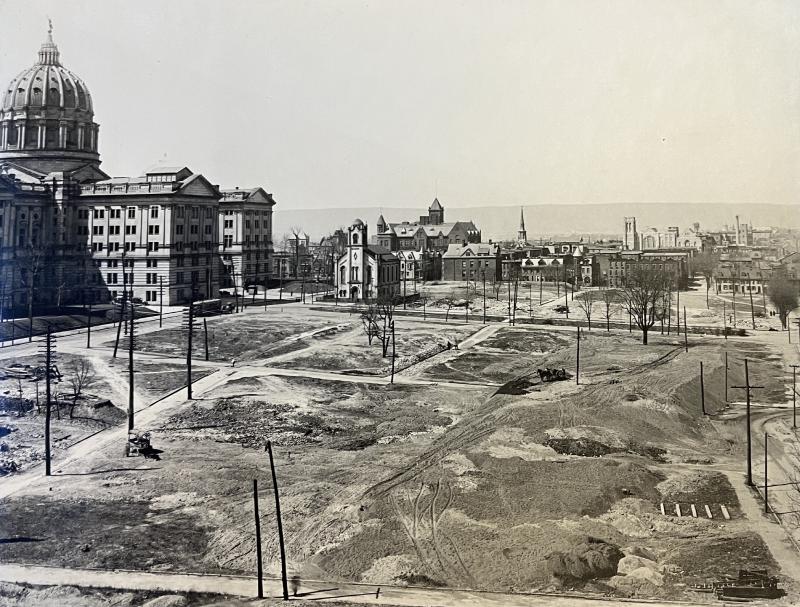
After the Infirmary’s closing in 1899, the Keeley Institute moved back into the James Russ House in 1901, where it likely remained until about 1908. The James Russ House then served as a boarding house until the building’s destruction around 1913 as part of the demolition of the Eighth Ward and the creation of the new Capitol grounds.
Despite the infirmary’s closure, the sisters continued their work at the Mercy Home and St. Genevieve’s Academy, where they provided low-income housing to women and children in the community. Mother Clare retired as Superior of the Harrisburg Foundation in 1902, but continued to serve in the Mercy Home and St. Genevieve’s Academy until her death on June 16, 1911. Although the infirmary and the community no longer exist today, the compassion of Mother Clare and the Sisters of Mercy added to the positive reputation of the infirmary and created a space of unity and care in Harrisburg. Mother Clare’s strong religious beliefs, combined with her emphasis on helping the poor, established a notable Catholic presence in the city that remains to this day. 
J. Howard Wert, a well-known columnist for the <i>Harrisburg Patriot</i>, described the Infirmary’s excellent service:</p><p><blockquote style="margin-left:40px;padding-left:20px;border-left:3px solid #ccc;">During the Spanish-American war . . . the work of this St. Clare Infirmary became especially conspicuous. Many a stricken soldier had reason to bless its shelter and thank God for the ministering care of those devoted Sisters of Mercy. Mother Clare now rests beneath the low green tent toward which we are all trending, but I would be recreant in my duty, if, in this connection, I did not place a wreath of recognition and laudation on her tomb.</blockquote>
</p><p>A full list of the resources used in this story can be found<a href="https://www.zotero.org/groups/5114087/harrisburg_historical/collections/743XH4ZJ"> here.</a></p><p><em><strong><a href="https://harrisburghistorical.org/items/show/30">For more (including 4 images) view the original article</a></strong></em></p>]]></summary>
    <published>2025-07-09T20:28:37+00:00</published>
    <updated>2026-09-01T20:23:50+00:00</updated>
    <link rel="alternate" type="text/html" href="https://harrisburghistorical.org/items/show/30"/>
    <id>https://harrisburghistorical.org/items/show/30</id>
    <author>
      <name>Hannah Boes</name>
    </author>
  </entry>
  <entry>
    <title type="html"><![CDATA[The Phyllis Wheatley YWCA : Black Women Activists of Twentieth-Century Harrisburg]]></title>
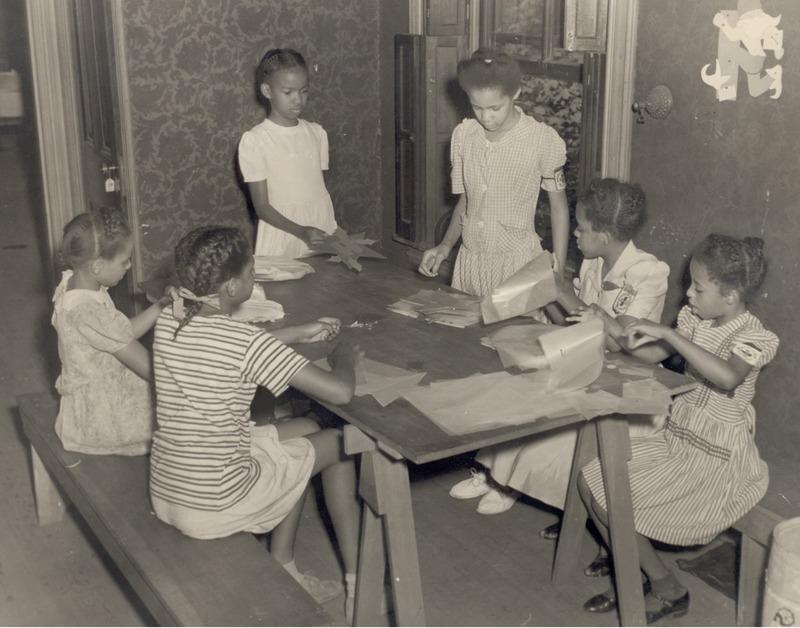
    <summary type="html"><![CDATA[<p><strong><em>The Young Women’s Christian Association, or YWCA, has been active in Harrisburg since 1894. The organization offered language and dance classes, as well as affordable housing, to local (white) women. In 1920, the Phyllis Wheatley branch of the YWCA was opened in Harrisburg. Named after the famous African American poet, the Phyllis Wheatley branch was dedicated specifically to addressing the needs of Harrisburg’s Black women.</em></strong></p><img src="https://harrisburghistorical.org/files/fullsize/ef1615c4569c9fb0dc6ae34487fc9610.jpg" alt="Children at Harrisburg YWCA&#039;s Phyllis Wheatley Branch" /><br/><p>On Cowden and Briggs, a street corner that no longer exists, stood the Odd Fellows building, owned by the Odd Fellows Fraternal Order, with a large room that served as the Phyllis Wheatley branch of the Young Women’s Christian Association. Next door sat a house owned by the YWCA with sleeping facilities available for the women. The YWCA, and nearby YMCA, represented a primary social center of the Black community in the 1920s and 1930s, hosting concerts, clubs, and events available to the local children and adults. <p>The Phyllis Wheatley Branch of the nationwide YWCA was organized in Harrisburg, Pennsylvania, on April 1, 1920, at a time when the social and civic lives of Black and white residents were sharply divided and segregated. The Phyllis Wheatley branch began with 123 members, a number that would flourish as the community took advantage of the resources and programs offered. The Phyllis Wheatley branch, alongside the Forster Street YMCA, was formed from the War Camp Community Service that had provided for World War I soldiers. According to news editor Joe McClure, the Harrisburg YWCA was dedicated to the “recreational, educational, social and religious development of Black women and girls.” The Phyllis Wheatley YWCA branch was a center for solidarity and camaraderie, serving as a safe haven for many Black women. The YWCA helped the region’s Black community combat white nationalism, promote activism, and provide a place for youth through its after-school programs. </p><p>The Phyllis Wheatley YWCA was a refuge with educational programs, home assistance, and spaces for women to be cared for and respected. The branch was named after Phyllis Wheatley, the famous Black poet (1753–1784) who wrote of the challenges she faced during her enslavement. The Phyllis Wheatley branch was named in her honor due to her inspiration for the Black community and the YWCA’s mission of empowerment.</p><p>The Phyllis Wheatley branch developed under the direction of numerous influential leaders throughout the twentieth century, the primary being Mrs. Maude Coleman (1882–1954). Maude B. Deering Coleman, married to John W. Coleman, was born in Virginia but fled the South, becoming a waitress in Harrisburg before the couple moved to Seattle, from 1911 to 1919. During her time in Seattle, Coleman gained significant experience with the YWCA and its role in political and social service. She reportedly received social work training from the University of Washington before they returned to Pennsylvania. According to historian Carrie Streeter, Coleman’s experience and training in Seattle allowed her “to secure a position as the first executive secretary of Harrisburg’s newly opened Phyllis Wheatley YWCA." Once there, she created basketball teams and gymnastics classes for young girls, formed a storytelling club, and, Streeter notes, “arranged for a local lawyer to teach classes in citizenship, a move that coincided with women’s newly ratified right to vote." Coleman wanted to provide safety to women within the Harrisburg community and fought to combat racial discrimination and promote resilience. Coleman was recognized for her service through her appointment as a special representative of the Pennsylvania Department of Welfare in 1924 by Governor Gifford Pinchot (s. 1923–1927; 1931–1935). </p><p>Another influential woman, Ella Frazier (1886–1977), came to Harrisburg in 1923 and became the second executive director of the YWCA Phyllis Wheatley branch. Frazier entered neighboring communities, promoting the YWCA to any young woman she could find. She encouraged young women to become involved in “productive activities” emphasizing etiquette and skills that would provide employment opportunities for women. Mr. Quann, a member of the YMCA, remembered Ella Frazier as “the driving force behind the YWCA” and said, “she kept that organization going and going and going." Ella Frazier was an impactful member of the YWCA, driven to support and assist as many young women in the community as possible, dedicating thirty-two years to the YWCA mission before retiring in 1955. </p><p>The Phyllis Wheatley YWCA was a prominent feature in the Harrisburg community that impacted its members through the attention given to educational, social, and political aspects of life. An announcement published on January 14, 1930, in <i>The Evening News</i>, a local newspaper, lists classes the YWCA offered to the community including sewing, gymnasium, glee club, piano class, arts and crafts, Bible study class, and home nursing. Additionally, the YWCA hosted events throughout the year including an annual Christmas dinner and program and a “Hanging of the Greens” for younger groups to celebrate the Christmas season. One highlight of the social events was the formal dance hosted by the Phyllis Wheatley YWCA and the Forster Street YMCA. Mr. Robert Quann, a Harrisburg resident in the 1920s, reflected on the formal dances where “you always gave your girl a corsage, you just had to do that and you had to wear a boutonniere . . . and you just couldn’t be dressed wrong, not for that.” The YWCA and YMCA were committed to supporting the lives of their community and providing opportunities for people to improve all aspects of their lives.</p><p>Frazier’s retirement coincided with the relocation of the Phyllis Wheatley branch to the main branch, after the original building was demolished in 1954 along with Maude Coleman’s home as part of the Second Capitol Extension. In an effort to make more space for the Capitol Complex, the state government repossessed buildings, including residences and community centers, against the protests of Harrisburg citizens and organizations. The Health and Welfare building was added in the 1950s where the Odd Fellows Hall once stood after its forced seizure. </p><p>Today, the YWCA serves the area with a focus on “economic development, veterans services and violence prevention,” and committed itself to a core mission “to empower women and eliminate racism.” Additionally, the YWCA aims to help victims of human trafficking through grant funding from the United States Department of Justice. U.S. Attorney David J. Freed wrote about the YWCA: </p><p>“Over the course of my career in public service, I have had the opportunity to work together with the dedicated staff at the YWCA of Harrisburg on behalf of victims of Domestic Violence, Sexual Assault, Human Trafficking and Stalking . . . With a small staff and a limited budget, the YWCA provides direct services and advocacy to some of our most vulnerable citizens.”</p><p>Because of the dedication and hard work of the founders, leaders, and organization members, the YWCA of Greater Harrisburg has created a lasting impact on the Pennsylvania community and continues to honor Phyllis Wheatley and her inspiring legacy. </p><p>A full list of the resources used in this story can be found <a href="https://www.zotero.org/groups/5114087/harrisburg_historical/collections/7WPRB7FC">here</a>.</p><p><strong>Related Stories</b></p><p><a href="https://harrisburghistorical.org/items/show/10">The Second Capitol Extension of Harrisburg, Pennsylvania</a></p><p><a href="https://harrisburghistorical.org/items/show/19" target="_blank" rel="noreferrer noopener">The Rowland Beauty School</a></p><p><em><strong><a href="https://harrisburghistorical.org/items/show/17">For more (including 5 images&#32;&amp;&#32;2 audio files) view the original article</a></strong></em></p>]]></summary>
    <published>2024-07-20T13:54:54+00:00</published>
    <updated>2026-04-17T19:49:02+00:00</updated>
    <link rel="alternate" type="text/html" href="https://harrisburghistorical.org/items/show/17"/>
    <id>https://harrisburghistorical.org/items/show/17</id>
    <author>
      <name>Elizabeth Movinsky&amp;#32;&amp;amp;&amp;#32;Sarah Meeks</name>
    </author>
  </entry>
  <entry>
    <title type="html"><![CDATA[Black Politics and City Beautiful: Dr. William H.C. Jones and the Eighth Ward]]></title>
    <summary type="html"><![CDATA[<p><strong><em>During a time when African American voices were rarely heard, Dr. Jones convinced Black residents of Harrisburg to offer their needed support to the City Beautiful movement.</em></strong></p><img src="https://harrisburghistorical.org/files/fullsize/e4b3b21d149e137327393a2c9dd00a8a.jpg" alt="Dr. William H.C. Jones" /><br/><p>On December 20, 1900, Mira Lloyd Dock gave a presentation before the Harrisburg Board of Trade with nearly one hundred slides comparing Harrisburg’s badly maintained riverfront with those of some well-kept cities in Europe. She argued that Harrisburg had the space and natural resources to be sanitary and beautiful if the city put in the effort. Her speech sparked the City Beautiful movement that spanned 1901 to 1915 and resulted in a new capitol building, street and sewage improvements, and additional parks and playgrounds. To do all that, Dock needed support from the Board and Harrisburg’s communities. As a member of the Board of Trade, Dr. William H.C. Jones, Jr. was at Dock’s speech and became the only Black member of the Municipal League for Civic Improvement, a group organized in May 1901 to drive the movement. The League needed the support of the Eighth Ward where Jones lived, so he used his respectability to influence the large African American and immigrant populations there to endorse the beautification of Harrisburg.<p>Dr. William H.C. Jones, Jr. was born in 1860 in Snow Hill, Maryland, to William H. and Esther Jones. He studied medicine at Howard University and the New York Polyclinic Institute before moving to the Eighth Ward of Harrisburg in September 1887. He was a highly respected medical professional and played an active role in a variety of Harrisburg communities with both Black and white residents, especially those in the Eighth Ward. A generous man, he donated to poor houses, flood survivors, and John Harris’s Memorial.</p><p>One of his obituaries described him as someone who was “active in the advancement of Harrisburg, and [prominent] in professional and business life.” Indeed, he was appointed to a juvenile court board of inquiry in 1902 and elected as a School Board Director representing the Eighth Ward from 1902 to 1904. He was president of the Baker Building and Loan Association and a member of the John Harris Memorial Committee. He served as a common councilman for the Eighth Ward and the medical examiner of Brotherly Love Lodge, No. 896, Grand United Order of Odd Fellows. Professionally, he was a member of the American Medical Association and the Pennsylvania State Medical Society, a charter member of the Harrisburg Academy of Medicine, and the only Black man to serve as president of the Dauphin County Medical Society.</p><p>Deeply involved in the communities of Harrisburg, Jones championed the City Beautiful movement from 1901 until his death on January 19, 1905. He wanted to convince the African American community in the Eighth Ward that improving the city would bring much-needed changes to the city. The Eighth Ward was not only one of the most densely populated areas of the city, but the primary neighborhood for African American residents; white populations of lower socio-economic status; and immigrants from Hungary, Italy, Greece, and the Russian-occupied territories, among others. Jones, along with several others in the ward, pushed the neighborhood to support the improvements. Due to his strong relationships and influence in the community, he was able to use his medical knowledge and leadership to help gather support for the city improvement project.</p><p>The committee appointed by the Board of Trade in 1901 was tasked with organizing a mass meeting of citizens to discuss how to improve Harrisburg. As an original member of this group, Jones presided over meetings within the Eighth Ward. He led the first meeting that occurred at the Wesleyan African Methodist Episcopal Church on January 31, 1902, just before the city-wide vote to decide on the changes proposed by the Harrisburg City Municipal League. Newspapers, including the <i>Harrisburg Patriot</i>, noted hundreds in attendance. Jones and other notable leaders spoke at the gathering, including Reverend F. H. Hill, the pastor of the church; Spencer C. Gilbert, a board member for Public Works; and J. Horace McFarland, a key architect of the City Beautiful movement. All of these speakers emphasized their desire for change, progress, and overall beautification of the city. They also included demonstrations emphasizing health benefits and plans for cleanliness, two major driving forces for the movement.</p><p>Since companies had been dumping sewage waste into the Susquehanna River for several years, Jones was convinced that informing residents about its connection with disease would help gather support to clean it up. By conserving Paxton Creek and the banks of the Susquehanna River, Jones believed that residents of the whole city would benefit physically from the sanitized water. Similarly, parks would beautify the city while providing clean places to be outside. During the time that Jones served as president of the Dauphin County Medical Society, the organization recommended specific quarantine periods for diphtheria and scarlet fever to the sanitary committee. At the same meeting, other groups addressed sites for parks, the installation of sewers, and the addition of more telephone lines in the city. Jones continually argued for better sanitation, while he worked to gather support and money for the movement in the Eighth Ward. As a resident of the ward and the only Black member of the Municipal League for Civic Improvement, Jones had a unique opportunity to shape conversations surrounding the ward and the movement.</p><p>The neighborhood of the Eighth Ward was an ethnically diverse community within Harrisburg City. While representation was poor and many voices of the African American community were left out of the decision-making process, prominent leaders like Jones led the community to support the movement. Jones’s main influence was in the first precinct of the Eighth Ward, the southernmost district where many African Americans resided. This precinct voted overwhelmingly in favor of improvements in 1902. Of the 272 votes recorded for the bond issue that year, 261 voted in favor of improvement. This 96 percent acceptance rate was the highest of any of Harrisburg’s precincts. Jones’s efforts created a tentative bond of trust between residents of the Eighth Ward and city leadership looking to build a stronger capital city.</p><p>On the morning of January 19, 1905, Dr. William Harrison Jones, Jr. tragically died, at age forty-four, from double pneumonia after a fall down the Capitol building's steps weakened his body. His fiancé, Margaret Lewis, was at his side when he passed away. Many prominent citizens spoke at his funeral, including Dr. Charles H. Crampton, the future deputy secretary of the State Health Department; Thomas McDowell Jones, an associate editor of the <i>Harrisburg Daily Telegraph;</i> and Benjamin Matthias Nead, a lawyer and politician. The eulogies they gave commended Jones as a businessman, physician, Christian, citizen, philanthropist, and educator. After this untimely loss, the community commemorated his life with the Dr. William Harrison Jones Memorial Entrance and Fountain to a 12th Street playground in 1915. An automobile parade celebrating fifteen years of public improvements in Harrisburg included the dedication of the memorial entrance. This allowed people to formally recognize Jones’s contributions to the City Beautiful movement as a talented doctor and dedicated leader.</p><p>A full list of the resources used in this story can be found <a href="https://www.zotero.org/groups/5114087/harrisburg_historical/collections/P2BGENTE">here</a>.</p><p><strong>Related Stories</b></p><p><a href="https://harrisburghistorical.org/items/show/10">The Second Capitol Extension of Harrisburg, Pennsylvania</a></p><p><em><strong><a href="https://harrisburghistorical.org/items/show/15">For more (including 7 images&#32;&amp;&#32;2 audio files) view the original article</a></strong></em></p>]]></summary>
    <published>2024-07-20T13:51:08+00:00</published>
    <updated>2026-04-17T19:49:02+00:00</updated>
    <link rel="alternate" type="text/html" href="https://harrisburghistorical.org/items/show/15"/>
    <id>https://harrisburghistorical.org/items/show/15</id>
    <author>
      <name>Kyle Shively&amp;#32;&amp;amp;&amp;#32;Emmy Varner</name>
    </author>
  </entry>
  <entry>
    <title type="html"><![CDATA[Maude Coleman and the Case Against Harrisburg&#039;s Second Capitol Extension : The Defense of the Seventh Ward ]]></title>
    <summary type="html"><![CDATA[<p><strong><em>In 1950, the prominent Maude Coleman, Interracial Consultant for the Commonwealth of Pennsylvania, wrote a letter to Governor James Henderson Duff advocating for the rights of Black homeowners of the Seventh Ward. In it, Coleman continued her fight to combat the state's seizure of property in her neighborhood.</em></strong></p><img src="https://harrisburghistorical.org/files/fullsize/7ee4dec21fd47f765423d3bfb6630a06.jpg" alt="Walnut and Short Looking North Toward Capitol, January 4, 1918" /><br/><p>In the first half of the twentieth century, during a time of radical change and social upheaval following the Reconstruction period, urban African American communities found themselves at a crossroads of uncertainty. The multiethnic neighborhoods east and northeast of the Pennsylvania State Capitol Building had faced similar circumstances through the First and Second Capitol Extension Projects carried out by the State legislature between the 1910s and 1950s. Those living in these neighborhoods did not capitulate without a fight, with one individual in particular, a community organizer named Maude Coleman, publicly writing to the state governor to affirm the value of her home and those of her neighbors. The letter to the Second Capitol Extension project renewed awareness of the unjust seizure of property in the diverse communities within the City of Harrisburg. </p><p>The appropriation of neighborhoods for the construction of Pennsylvania government buildings took place during multiple decades, beginning in the early twentieth century. North Street formed the divider between the destruction of properties in the "First Capitol Extension" and the "Second Capitol Extension." The first extension was passed by an act of the Pennsylvania Assembly in 1911 and claimed the section of the Old Eighth Ward defined by today's Walnut Street, Seventh Street, North Street, and Commonwealth Avenue. The Capitol Park Extension Commission invested thirty-six million dollars post-1913 to demolish twenty-nine acres (and 538 buildings) east of the Capitol building to create new state government buildings and recreational land by the early 1930s. In 1941, the Capitol Grounds Extension Planning Committee led by J. Horace McFarland outlined a proposal for a second extension and the acquisition of twenty-three more acres between North Street and Forster Street, from Third to Seventh Street across the northeastern corner of the Fourth Ward, and most of what remained of the Old Eighth Ward. This area contained 334 properties with 176 specific owners and a sizable residential population, of whom 50 percent were African Americans. Further extensions in the 1950s claimed neighborhoods north of Forster Street in the southern part of Harrisburg's Seventh Ward.</p><p>It was not uncommon for local, state, or federal officials to factor in race for urban planning efforts during the early to mid-twentieth century. Often, city planners applied generalized stereotypes of poor living conditions in diverse communities to accomplish their goals. In the case of the communities outlined for the initial phase of the Second Extension, the 1935–1936 Home Owners’ Loan Corporation survey noted that the homes between Third and Sixth Street possessed “considerable new paint and good exteriors” as opposed to remaining sections of the Old Eighth Ward to the east which was “run down [and] neglected” and was occupied by “alien white, negroes, and less desirable native whites.” In the planning report, these supposedly run-down homes were labeled as fire hazards (27 percent), with around 30 percent having outdoor plumbing. The planners also outlined other reasons to justify why the location should be purchased, including the improvement and widening of roads to ease traffic and to replace substandard buildings with favorable land for future construction projects. </p><p>The report prepared by the Capitol Grounds Extension Planning Committee was expansive, covering the usability of the extension area; the status and quality of its buildings and owners; the cost factors relating to how properties were to be acquired; the ways in which their project was to be financed; external legal aspects, the block plan; and a seven-step list of ways the extension area was to be further developed. Even still, the document does not offer any specific evidence regarding the social, cultural, or genealogical characteristics of those who lived in the second extension properties. There is, however, a blueprint of the area with a corresponding list of all the property owners as of 1930 (see Plan of Properties, below).</p><p>The Second Capitol Extension began in early 1942, one year after the report’s publication and twelve years after the 1930 property assessment blueprint. During the next decade, the Pennsylvania government seized properties in the designated area north of the Capitol Complex, but also expanded well beyond the originally planned district into the neighborhood of the Seventh Ward north of Forster Street. When Maude Coleman received a notice that the Capitol Park Extension planned to confiscate houses on her own block to create office space for the Department of Labor and Industry, she shared her feelings with then-Pennsylvania Governor James Duff. </p><p>Coleman was born in 1879 and lived briefly in the Old Eighth Ward until the First Capitol Extension claimed her property in 1912. Later, Coleman lived on Boas Street in the Seventh Ward from 1920 to 1953. On February 20, 1950, Coleman sent a letter to Governor Duff on behalf of a friend. Coleman was familiar enough with Pennsylvania's governors because of her intermittent service as Interracial Consultant from 1924 to 1953. Coleman used her professional capacity to appeal to Duff on behalf of the predominantly African American community located in and around the Second Extension area. While not located in the area initially proposed in the 1930 report, her neighborhood on Boas Street lay just one block north of Forster Street and marked the target for new appropriations in the 1950s. Coleman’s letter to Duff argued that the conditions for African Americans to acquire (new) housing in Harrisburg were “absolutely impossible” due to unwritten restrictions within the city. Additionally, Coleman pointed out that the homes in the extension area were not slum houses as the Planning Commission labeled them. Some of the occupants of this neighborhood included “ . . . our only Negro druggist in Central Pennsylvania, a practicing physician, a mortician, the best tourist home for Negroes in the city, and State and city employees.” In her view, they numbered "among the best homes for Negroes in Harrisburg."</p><p>Maude Coleman’s plea for consideration was ignored. In the end, Coleman's home met the same fate as 500 other properties of the Fourth, Seventh, and Eighth wards removed during the execution of the First and Second Capitol Extensions. Coleman's house at 641 Boas Street became the parking lot north of the Pennsylvania Labor and Industry Building where, ironically, stands the Pennsylvania Worker Statue today — a sculpture designed to honor the state's working population. The construction of office buildings, parkland, the Pennsylvania State Museum, and the former site of the Pennsylvania State Archives has shrouded the histories of hundreds of residential properties like that of Maude Coleman beneath the administrative facilities of the state.</p><p>A full list of the resources used in this story can be found <a href="https://www.zotero.org/groups/5114087/harrisburg_historical/collections/H8H94BBI">here</a>.</p><p><strong>Related Stories</p><a href="https://harrisburghistorical.org/items/show/17">The Phyllis Wheatley YWCA</a></p><p><a href="https://harrisburghistorical.org/items/show/6">A Gathering at the Crossroads</a></p><p><a href="https://harrisburghistorical.org/items/show/15">Black Politics and City Beautiful</a></p><p><a href="https://harrisburghistorical.org/items/show/7">Green Book Harrisburg</a></p><p><em><strong><a href="https://harrisburghistorical.org/items/show/10">For more (including 5 images&#32;&amp;&#32;2 audio files) view the original article</a></strong></em></p>]]></summary>
    <published>2024-03-25T01:17:05+00:00</published>
    <updated>2026-04-17T19:49:02+00:00</updated>
    <link rel="alternate" type="text/html" href="https://harrisburghistorical.org/items/show/10"/>
    <id>https://harrisburghistorical.org/items/show/10</id>
    <author>
      <name>Kelan Amme</name>
    </author>
  </entry>
  <entry>
    <title type="html"><![CDATA[A Gathering at the Crossroads: The Story of the Commonwealth Monument]]></title>
    <summary type="html"><![CDATA[<p><strong><em>In 2020, as communities around the nation took down monuments symbolizing the legacies of American slavery, Harrisburg residents set up a monument to African American history and the power of the vote. </em></strong></p><img src="https://harrisburghistorical.org/files/fullsize/deaad0b9295abae0a1dfa266d3e54656.jpg" alt="A Gathering at the Crossroads" /><br/><p>On August 26, 2020, <em>A Gathering at the Crossroads</em> commemorated the anniversaries of the Fifteenth and Nineteenth  Amendments through the installation of a monument to Harrisburg’s Black history. 150 years after the right to universal male suffrage was granted to the people of the United States, and 100 years after women's suffrage was established, 2020 marked the intersection of the legacies of past achievements, and the inconsistencies and obstacles of the present. Beginning in the Spring of 2020, protests against police brutality toward Black Americans swept the nation, calling attention to continued injustices in American society. </p><p>At the height of this racial reckoning, a new bronze monument was placed on the Irvis Equality Circle, which marks the south <span>lawn of the Speaker K. Leroy Irvis Office Building </span>in Harrisburg’s Capitol Complex. A little more than a century ago, neither the Circle nor the expansive Capitol building existed. The area where this monument now stands was once a part of the Old Eighth Ward known as Tanner’s Alley, a predominantly African American neighborhood. Instead of lush green spaces and domed ceilings, this part of Harrisburg was filled with thriving churches, schools, businesses, and private residences. In the early twentieth century, however, these spaces were torn down and families were forced out of their homes due to the Capitol expansion project. The City Beautiful movement started as a push to create new green spaces and waste disposal measures that would benefit the entire community, but by the 1910s, it had morphed into a drive to complete the Capitol Complex that stands today. The Old Eighth, home to significant Black, Jewish, and immigrant populations, was demolished and residents were forced to relocate. For many years, their names and stories were forgotten. </p><p>The monument at Irvis Equality Circle is, to date, the only monument on the Capitol grounds honoring Harrisburg's Black community. The Commonwealth Monument Project is an initiative of the the International Institute for Peace through Tourism and was led by Lenwood Sloan (Executive Director), Jeb Stuart (Secretary of Logistics and Installation), Kelly Summerford (Treasurer), Phyllis Bennett (Government and Business Liaison), and Valerie Leblanc (Planning and Development). It enjoyed bipartisan support from both the Pennsylvania House of Representatives and Senate, along with major financial contributions from the City of Harrisburg, the Foundation for Enhancing Communities, Peggy Grove, Dauphin County Commissioners, Messiah University, Senator Sharif Street, and many other generous donors. </p><p>Artist Becky Ault and Art Design Group crafted four life-sized bronze statues of African American orators, each of whom made major contributions to the quest for racial justice in America and have a meaningful connection to the city of Harrisburg. These include, from left to right: </p><p>Thomas Morris Chester (1834–1892), a Civil War correspondent and Harrisburg native. In 1863, he became the captain of one of Harrisburg’s Union companies. Through 1864, Chester reported on the war effort, particularly the contributions of African American troops. Most newspapers completely overlooked the African American soldiers, but through Chester’s journalism, papers such as the <em>Philadelphia Press</em> printed information about them. After the war, Chester returned to Harrisburg where he became the secretary of the newly founded Garnet Equal Rights League, which advocated for Black rights and freedoms. This section of Walnut Street is named the "T. Morris Chester Way" in his honor.</p><p>Jacob T. Compton (1836–1905), sergeant in Company D of the 24th United States Colored Infantry (USCT) and local musician. In the Harrisburg community, Compton was known for leading the choirs of both African Methodist Episcopal and African Methodist Episcopal Zion churches, and for founding the Excelsior Band. Compton was also a carriage driver. Among the ranks of his passengers was Abraham Lincoln, soon to be the sixteenth president of the United States. In February 1861, before his inauguration, president-elect Abraham Lincoln visited Harrisburg. When an assassination plot was uncovered, it was Compton who <span>drove the getaway carriage.</span></p><p>The third figure, Reverend William Howard Day (1825–1900), was a prominent educator and orator, and one of America’s most renowned civil rights activists of his time. His contributions to Harrisburg were plentiful. In the 1870s, Day was appointed to the Harrisburg School Board of Directors. He successfully led the board in allocating funds to public schools for new textbooks and blackboards. Day fought for better education for African Americans both by improving the schools that existed for African American students and by beginning the process of integration at Harrisburg’s all-white Boys High School. Day was also an active community leader at the Wesley Union African Methodist Episcopal Zion Church on South Street. </p><p>The final figure on the right is Francis Ellen Watkins Harper (1825–1911), who fought for the abolition of slavery, women’s suffrage, and temperance. This statue of Francis holds the Fifteenth Amendment, which guaranteed universal male suffrage. She is depicted passing the document back to Day, demonstrating that there was still more to do: women were not yet enfranchised. Harper was a renowned antislavery journalist, poet, and public speaker, who gave lectures in cities across the United States, including Harrisburg. One of her most famous speeches, “We Are All Bound Up Together,” expressed the frustrations of Black women at being largely excluded from the women’s suffrage movement and called for universal voting rights.</p><p>These four visionaries surround a pedestal at the center of the monument. A model of the Old Eighth Ward sits on top. A blue star indicates the location of the monument relative to the vanished landscape of the Old Eighth Ward. The sides of the pedestal bear the names of one hundred influential Black residents of Harrisburg. These individuals were freedom seekers, abolitionists, suffragists, church leaders, doctors, businesspeople, poets, and more. All called Harrisburg home, and all fought for a better, more equitable city. </p><p>The impact of the many Black Americans honored by <em>A Gathering at the Crossroads</em> is not confined to this space on Walnut Street. Their legacies are everywhere: in Harrisburg’s school system, churches, cemeteries, and homes. Some of their stories have been explored throughout the “Chester Way” tour. Each location highlights a moment in time when Harrisburg’s residents spoke out against oppressive structures and ushered in radical change in areas of education, politics, and social life. As you reflect on each stop on the tour, you may discover something new about the capital city’s history and find yourself at a different kind of “crossroads,” as the struggles, hopes, and triumphs of the past intersect with the aspirations of the present. </p><p>A full list of the resources used in this story can be found <a href="https://www.zotero.org/groups/5114087/harrisburg_historical/collections/3WI8N8R7/items/7RE3X2J3/collection">here</a>.</p><p><strong>Related Stories:</strong></p><p><a href="https://harrisburghistorical.org/items/show/10">The Second Capitol Extension of Harrisburg, Pennsylvania</a></p><p><a href="https://harrisburghistorical.org/items/show/4">The Lincoln Street School</a></p><p><a href="https://harrisburghistorical.org/items/show/13">Lincoln's Close Call</a></p><p><a href="https://harrisburghistorical.org/items/show/12">It's a Family Business</a></p><p><a href="https://harrisburghistorical.org/items/show/18">Taking the Moose Lodge to Court</a></p><p><em><strong><a href="https://harrisburghistorical.org/items/show/6">For more (including 6 images, 2 audio files,&#32;&amp;&#32;1 video) view the original article</a></strong></em></p>]]></summary>
    <published>2023-11-01T15:40:47+00:00</published>
    <updated>2026-04-17T19:49:02+00:00</updated>
    <link rel="alternate" type="text/html" href="https://harrisburghistorical.org/items/show/6"/>
    <id>https://harrisburghistorical.org/items/show/6</id>
    <author>
      <name>Alexandra Shehigian</name>
    </author>
  </entry>
  <entry>
    <title type="html"><![CDATA[The Lincoln Street School: Educational Inequity and Reform during the Nineteenth Century]]></title>
    <summary type="html"><![CDATA[<p><strong><em>The Lincoln School was one of several institutions founded in the 1860s and 1870s to address the lack of quality education opportunities for Black students in Harrisburg. It stood as a testament to the strides toward educational reform in the late nineteenth century and the work left to be done.</em></strong></p><img src="https://harrisburghistorical.org/files/fullsize/e11d19d15b7995eef6808f61be58b63a.jpg" alt="The William Howard Day School" /><br/><p><em>More advantages should be procured for the further advancement of our children in knowledge, so as to fit them to occupy the various positions that are every day opening to our people, and not only that, but to sufficiently qualify them for the business pursuits of life.</p>— William Howard Day, speech quoted in the <em>Harrisburg Telegraph</em>, Dec. 11, 1874</p><p>In early-nineteenth-century Harrisburg, Black children had limited access to formal education. The public school system was segregated and the provision of classroom spaces fell upon Black churches. In 1817, the Wesley Union Zion African Methodist Episcopal church-run Franklin Hall opened its doors to pupils. Such church schools served as Black Americans’ primary form of access to education until after the Civil War. Some Black students enrolled in the Lancasterian School on Walnut Street, founded in 1827. The school provided free education to a racially diverse group of students until the city closed it in 1834 on the grounds that it was not sufficiently profitable. Harrisburg’s “first integrated school” was then replaced by the all-white DeWitt School for Boys. </p><p>One approach to addressing the educational inequity in Harrisburg was to establish schools specifically for the Black population. Under the guidance of State Superintendent of Public Instruction James P. Wickersham, Harrisburg constructed several schools in majority-Black neighborhoods in the Sixth and Eighth Wards. One such institution was the Lincoln School, which opened at the corner of North and Fifth Streets in 1871. Led by Principal Spencer P. Irvin, the Lincoln School was widely known for its robust extracurricular offerings, including Christmas festivals, musical ensembles, and skilled athletics teams. </p><p>As much a testament to racially restrictive policy as to progress, the Lincoln School suffered from Harrisburg’s unwillingness to prioritize funding for Black institutions. While white schools received grants to expand their buildings and upgrade equipment, the Lincoln School went decades without receiving finances for renovations. Parents protested the injustice, noting how their children and teachers frequently contracted illness from the poorly ventilated rooms. Something more needed to be done. </p><p>Major strides in educational reform for Harrisburg’s Black population were made under the leadership of one of the most celebrated civil rights leaders of the era: Reverend William Howard Day. Originally from New York City, Day was an activist and orator who spoke out against slavery and, later, the subjugation of Black Americans in the United States. He also served as the Superintendent of Colored Schools in Maryland and Delaware in the late 1860s. Day arrived in Harrisburg in 1871 to work as the secretary for the auditor general-elect, but in 1874, he became directly involved in Harrisburg’s education system when he was appointed to the Pennsylvania Department of Education Board of Examiners. He held numerous other offices, serving as the first African American member of the Harrisburg School Board in 1878 and, in 1891, rising to become its president. At the time, he was the only Black school board president in the nation. While in office, Day oversaw the enhancement of schools for all children in Harrisburg, but was especially committed to improving the quality of education for the city’s Black students. </p><p>Recognizing the disparity between resources provided to white and Black schools, Day advocated tirelessly for the desegregation of Harrisburg’s education system. He called for the “abolition of white schools,” acknowledging that this was the surest path to ensure equitable access to resources for both Black and white students. Day also successfully decreased truancy rates across the city by implementing a more effective attendance system and allocated city funds toward the purchase of textbooks for all schools, including the majority-Black institutions.</p><p>Day also served as a mentor to Black students, encouraging them to own their education and pursue excellence. In the late 1870s, he advocated for two Black students at the Lincoln School, John P. Scott and William H. Marshall, to be admitted to the all-white Boys' High School. After excelling on their entrance exams, Scott and Marshall were the first Black students enrolled at the Boys' School in 1878. That same year, two African American girls, whose names have been lost to history, were the first to be admitted to the Girls’ School. These four students marked the first major victory of a century-long battle to integrate Harrisburg’s schools. When they graduated in 1883, both Scott and Marshall read commencement addresses. Scott pursued a career as an educator, remaining in the Harrisburg school system for forty-seven years. He ultimately returned to the Lincoln School as principal and, working alongside Day, helped establish a new library for its students. </p><p>The reforms of the 1870s and 80s were not the final strides of the education justice movement but its first steps. William Howard Day, John P. Scott, and their contemporaries helped bring the call for educational reform to the center stage of Harrisburg politics amid continued resistance from white residents. It would be their twentieth-century successors who picked up the mantle, and the students of the 1970s who would see the full realization of the dream for integrated schools. As for the Lincoln School, it was renamed the Day School in 1903, memorializing its friend and strongest supporter, William Howard Day. In 2020, Harrisburg unveiled a bronze statue of Day as part of the monument group called "A Gathering at the Crossroads" — a fitting reminder and celebration of the orator's legacy of change.</p><p>A full list of the resources used in this story can be found <a href="https://www.zotero.org/groups/5114087/harrisburg_historical/collections/P563VGMA">here</a>.</p><p><strong>Related Stories</p><a href="https://harrisburghistorical.org/items/show/3">Men of God</a></p><p><a href="https://harrisburghistorical.org/items/show/6">A Gathering at the Crossroads</a></p><p><em><strong><a href="https://harrisburghistorical.org/items/show/4">For more (including 4 images&#32;&amp;&#32;2 audio files) view the original article</a></strong></em></p>]]></summary>
    <published>2023-10-25T23:59:48+00:00</published>
    <updated>2026-04-17T19:49:02+00:00</updated>
    <link rel="alternate" type="text/html" href="https://harrisburghistorical.org/items/show/4"/>
    <id>https://harrisburghistorical.org/items/show/4</id>
    <author>
      <name>Alexandra Shehigian</name>
    </author>
  </entry>
  <entry>
    <title type="html"><![CDATA[Harrisburg&#039;s African Methodist Episcopal Churches: The Road to Emancipation]]></title>
    <summary type="html"><![CDATA[<p><strong><em>During the nineteenth century, the African American churches of Harrisburg were much more than houses of worship; they were agents of enfranchisement and liberation.</em></strong></p><img src="https://harrisburghistorical.org/files/fullsize/9448317b18fa8ff935d4157d3f4d961e.jpg" alt="Bethel AME,  Short Street View" /><br/><p>It was January 1, 1863. To many residents of Harrisburg, it was likely just a typical New Year's Day, but to the city's African American community, it held far greater significance as it marked the day the newly passed Emancipation Proclamation took effect. That evening, three chosen men met at the Bethel African Methodist Episcopal (AME) Church on Short Street to write a response to this momentous occasion. Not only did they encapsulate the joy and approval that African Americans felt, but also the anger and frustration that stemmed from two centuries of racial discrimination and dehumanization, warranting such a proclamation in the first place. By the end of that night’s worship service, the response was approved via a vote, simultaneously celebrating a win for African Americans worldwide while also acknowledging that work was far from over — work that Black churches in Harrisburg had already been doing for decades and would continue in the years ahead. 
The resolution composed by schoolteacher John Wolf, prominent community member Samuel Bennett, and Reverend David Stevens of the Wesley Union AME Zion Church may have captured what Harrisburg’s African American community felt about slavery, but their actions spoke louder. Despite its small stature, under the leadership of Reverend Mifflin Gibbs, the Bethel AME Church “included many of those who did man's work by day and the Lord's work by night, maintaining an active presence in that shadowy operation known as the Underground Railroad.” Understanding the difficulties that resulted from escaping slavery, the church provided housing for freedom seekers and found them employment in the local coal, iron, and steel industries, helping them settle into their new lives in the North, whether Harrisburg was their final home or merely a stop on the way. Later, following the ratification of the Fifteenth Amendment in 1870, Bethel AME took things a step further by registering new voters and offering classes in civic education, ushering in a new era of voting rights for the city. Although the Short Street church played a crucial role in the antislavery movement and in advancing the rights of African Americans, it was not alone. 
At the corner of Third and Mulberry Streets sat the small log building that housed the Wesley Union Church. Its neighborhood of “Judy’s Town” was a key spot for African American social and spiritual life, so it is unsurprising that it became the first of Harrisburg’s regular Underground Railroad stops, becoming the epicenter of the movement in the city by 1829. As at Bethel AME, many freedom seekers found refuge at Wesley Union, a direct result of the sermons that congregants heard during worship services, filling them with a sense of love and duty that inspired them to put everything on the line to help total strangers. One early Wesley Union congregant, William “Pap” Jones, was known for being one of the most effective Underground Railroad conductors in the area, using his extensive knowledge of northern routes to create guides for freedom seekers. Another congregant, Harriet McClintock Marshall, assisted freedom seekers by providing them with shelter, food, and clothing before ushering them to their next stops on their journeys to freedom; her husband’s status as a formerly enslaved man likely strengthened her resolve to help others on their journeys to freedom.
In fact, Harrisburg’s African American community was participating in Underground Railroad activities long before the Underground Railroad was established. For instance, Reverend David Stevens of Wesley Union Church encouraged his congregation to “strive for self-reliance and community,” a mission they fulfilled by assisting the needy in every way possible. The “needy,” of course, included enslaved people who had escaped from their bonds and were settling in the North. These actions led to the formation of a sort of network that connected different members of the Harrisburg African American community throughout the 1820s and 1830s under a common goal. Stevens and fellow African American minister Jacob D. Richardson publicly denounced slavery and opened the church to anti-slavery meetings and events, even attempting to start their own anti-slavery newspaper — <i>Zion’s Wesleyan Connection </i>— in 1841. The church continued to grow until their small log building in Judy’s Town was no longer big enough, leading founding pastor Stevens to seek out a new location at the corner of Tanner’s Alley and State Street, east of the Capitol building, where the congregation moved in its entirety in 1839. The construction of new buildings on the same site in 1862 and then again in 1894 demonstrates Wesley Union's success throughout the nineteenth century as it continued to flourish in spite of adversity. 
Churches such as Bethel AME and Wesley Union played a pivotal role in organizing Harrisburg’s Underground Railroad. From holding recruitment meetings for Black Civil War regiments to hosting national-scale anti-slavery speakers, houses of worship stood at the forefront of the city’s efforts to resist slavery and to support freedom seekers. Indifferent or discriminatory residents of Harrisburg may have viewed these African American men and women as "radicals" or lawbreakers, but in reality, they were fighting for justice and human dignity as children of God.<b></b></p><p>A full list of the resources used in this story can be found <a href="https://www.zotero.org/groups/5114087/harrisburg_historical/collections/6HAU588N">here</a>.
Related Stories</p><p><a href="https://harrisburghistorical.org/items/show/8">Harrisburg's Role in the Underground Railroad</a></p><p><a href="https://harrisburghistorical.org/items/show/5">Douglass in Harrisburg</a></p><p><a href="https://harrisburghistorical.org/items/show/4">The Lincoln Street School</a></p><p><a href="https://harrisburghistorical.org/items/show/2">Harrisburg's Lincoln Cemetery</a></p><p><em><strong><a href="https://harrisburghistorical.org/items/show/3">For more (including 5 images&#32;&amp;&#32;2 audio files) view the original article</a></strong></em></p>]]></summary>
    <published>2023-10-24T20:35:55+00:00</published>
    <updated>2026-07-05T18:14:55+00:00</updated>
    <link rel="alternate" type="text/html" href="https://harrisburghistorical.org/items/show/3"/>
    <id>https://harrisburghistorical.org/items/show/3</id>
    <author>
      <name>Rachel Petroziello</name>
    </author>
  </entry>
</feed>