In 1937, over one hundred Philadelphia teachers visited Harrisburg. Among them was a small group of African American educators. When the Penn Harris Hotel refused to serve food to African American principal Arthur H. Fauset and a handful of other teachers because of their race, their fellow visiting teachers declared a boycott of the hotel, igniting a debate surrounding Pennsylvania’s Equal Rights Law. As a matter of fact, the Pennsylvania law — which prevented denial of service based on race in a broad scope of “public places” — was a source of contention ever since its passage in 1935 on the grounds that it was too vague, supposedly rendering it ineffective. Appealing to this line of reasoning, Franklin Moore, chairman of the Hotel Association’s legislative committee and manager of the Penn Harris Hotel at the time of the 1937 incident, advised hotels not to comply. Therefore, not even the law protected Black travelers within Pennsylvania.
The Equal Rights Bill was declared valid in the end, but the whole situation nonetheless demonstrated the immense challenges that often came when traveling as an African American during Jim Crow, even in a northern city such as Harrisburg. Due to the rejection and discrimination that African Americans faced on the road throughout the United States, many turned to African American postal worker Victor H. Green’s Green Book for guidance on which businesses — including restaurants and hotels — would accept them and be safe for them in a Jim Crow environment. The Green Book, first published in 1936, listed several Harrisburg locations throughout its many editions. Today, only two remain standing, with only one still in operation. These businesses serve as a reminder of not only the hardships that African Americans faced when traveling, but also of the immense successes that Black business owners were able to achieve in spite of it all.
Jack’s Hotel was opened in 1946 by Calobe Jackson, Sr., father of prominent Harrisburg historian Calobe Jackson, Jr., who recalls that during his childhood, its location on North Sixth Street was vibrant and full of small businesses. Jackson, Jr. remembers the Green Book as something that offered African Americans a sense of comfort and safety, so they could travel without confrontation, an expectation that was no doubt fulfilled by Jack’s Hotel as well as Jack’s Barber Shop, another Green Book location that was owned by his father.
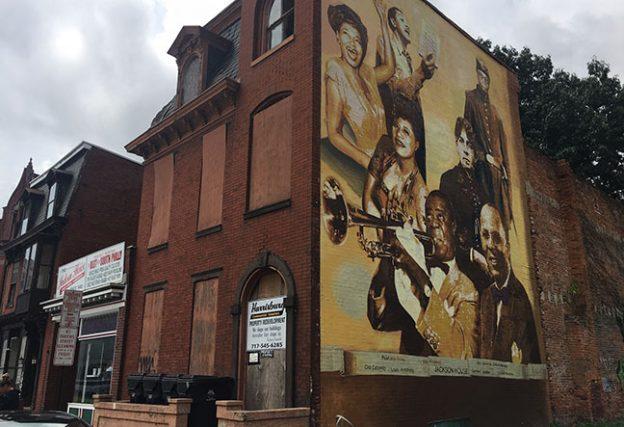
On the very same street, a different Jackson family was operating their own hotel, seemingly causing some confusion in the 1962 iteration of the Green Book. The Jackson House was founded by German Jackson, the son of an enslaved man who had come to Harrisburg in the 1920s as part of the "Great Migration," the steady movement of millions of Black Americans from southern states to the north to escape racial injustice and inequality. Working at the Penn Harris Hotel for more than thirty years did not deter German Jackson from operating his own business that attracted such clientele as boxer Joe Louis and bandleader Cab Calloway. Although the hotel portion of the Jackson House has since been demolished, its cafe is still standing. Today, it is owned and operated by German Jackson's friend, Dave Kegris, as the Jackson House sandwich shop. The Jackson House restaurant and the building that once housed Jack’s Hotel are not only Harrisburg’s final Green Book locations; they are also two of the last three remnants of the historic Seventh Ward, the African American business district of the early twentieth century, which was demolished during the 1950s in order to expand the Capitol Complex.
Even if most of Harrisburg’s historic Black businesses no longer exist in a tangible sense, their legacy lives on through the stories of those who built them — or advocated for them. African Americans fought for safe travel and accommodations decades before the Green Book’s publication. One of the most prominent figures was William (W.) Justin Carter, a Black attorney who participated in civil rights cases both locally in Harrisburg and nationally. In light of the Old Eighth Ward’s demolition during the 1910s, the Frye Hotel, a State Street hotel that welcomed African Americans, needed a liquor license in order to move to a new location at 1012 North Seventh Street. Alderman Charles P. Walter, the man in charge of the new property, had plans to build a modern, forty-room hotel there, declaring that Harrisburg needed a hotel that would serve traveling African Americans, and if the Frye Hotel was forced out of business because it was unable to relocate, then they would no longer have “adequate accommodations” when visiting the city.
It was not long before objections began rolling in. Some argued that the Frye Hotel would attract “unlawful” clientele to North Seventh Street, while others shuddered at the possibility of white and Black patrons being served together, leading owner Theodore Frye to “vigorously [deny] that white men or women [were] permitted to drink together in his State Street hotel.” Others yet claimed that North Seventh Street already had enough bars, raising the question of whether race should ever be a factor in the granting of liquor licenses, considering that there would be “no licensed [bars] conducted by a colored man” if the Frye Hotel closed. Defending the Frye Hotel, W. Justin Carter argued that a hotel for African Americans was a necessity, pointing to the fact that even though they were legally allowed to purchase liquor just as whites were for the same price, the act of doing so was often met with humiliation by racist bartenders. He also pointed out that in many hotels, while white patrons received pure liquor, African Americans were given “jigger” whiskey, described as a “concoction of cologne and alcohol.” A hotel catering mainly to African Americans, on the other hand, would give its patrons better treatment regardless of race.
Unfortunately, the Frye Hotel lost its legal battle, and was memorialized in a 1917 article in the Harrisburg Telegraph as “one of the most notorious dives of the city.” However, the work of W. Justin Carter was not in vain; he paved the way for Green Book locations such as Jack’s Hotel and the Jackson House, helping to inspire African Americans to create safe places for themselves if nobody else would. These places were not “notorious dives” as some in the past have argued. Rather, they were opportunities for African Americans to travel and to patronize businesses that welcomed them with open arms. Today we may have a habit of taking the ability to lodge at a hotel for granted, but the stories of those Black teachers in 1937, the two Jackson families, and W. Justin Carter’s defense of the Frye Hotel demonstrate that such a convenience has not always been so accessible for everyone.
A full list of resources used in this story can be found here.
Related Stories
The Second Capitol Extension of Harrisburg, Pennsylvania
Taking the Moose Lodge to Court
For more (including 5 images & 2 audio files) view the original article
]]>