<?xml version="1.0" encoding="UTF-8"?>
<feed xmlns="http://www.w3.org/2005/Atom">
  <title type="text">Harrisburg Historical</title>
  <updated>2026-04-17T19:49:02+00:00</updated>
  <generator uri="http://framework.zend.com" version="1.12.20">Zend_Feed_Writer</generator>
  <link rel="alternate" type="text/html" href="https://harrisburghistorical.org/"/>
  <link rel="self" type="application/atom+xml" href="https://harrisburghistorical.org/items/browse?output=rss2"/>
  <id>https://harrisburghistorical.org/</id>
  <author>
    <name>Harrisburg Historical</name>
    <uri>https://harrisburghistorical.org</uri>
  </author>
  <link rel="hub" href="https://pubsubhubbub.appspot.com/"/>
  <entry>
    <title type="html"><![CDATA[Jacob T. Compton: The Musician, Sergeant, and President&#039;s Coachman ]]></title>
    <summary type="html"><![CDATA[<p><strong><em>On a cold February night in 1861, President-elect Abraham Lincoln, en route to Washington D.C., spent an hour in a carriage with Jacob T. Compton, a notable Black coachman, musician, and liberated man. One went on to serve a contentious but impactful presidential term during the American Civil War; the other became an influential USCT sergeant, musician, activist, organizer, and minister.</em></strong></p><img src="https://harrisburghistorical.org/files/fullsize/a10de33cff77c9e0be01ebdf701e2124.jpg" alt="Jacob T. Compton Statue" /><br/><p>On the night before arriving in Harrisburg, Pennsylvania (February 20, 1861), president-elect Abraham Lincoln received word of an assassination plot planned for his expected journey through Baltimore. Harrisburg resident Simon Cameron, Lincoln's future Secretary of War, entrusted the president's safety to his coachman, Jacob Compton. In a matter of an hour, Compton swiftly escorted Lincoln and his family from their lodgings at the Jones House to a covert train bound for his inauguration in Washington, D.C. The whisking away of Abraham Lincoln was remembered for decades to come.</p><p>Lincoln's escort, Jacob Tilford Compton (Cumpton), was born on August 3, 1836, in Williamsport, Maryland, to Rebecca and Ezekiel Compton. Although his father was enslaved, his mother was free, which gave him the legal status of a Freeman. A year after his parents died of cholera in 1854, Compton left Williamsport after allegations surfaced that he had helped two men, George and John Butler, escape to Harrisburg. He reached Harrisburg, where he spent much of the rest of his life. </p><p>In Pennsylvania's capital city, Compton found employment first in a brickyard, where he once warded off an abduction attempt. Soon he met U.S. Senator Simon Cameron, who hired him as his personal coachman. It was through this connection that Compton later met the president-elect, who was journeying in 1861 from Illinois to Washington, D.C. </p><p>When Lincoln's aides learned of the plot to assassinate Lincoln in Baltimore, they made arrangements for a secret train to carry him to Washington, D.C. Lincoln agreed to the plan but only after honoring his commitment to attend the events planned by Pennsylvania Governor Andrew Curtin. Lincoln’s first stop was the Jones House, a hotel overlooking Market Square (later known as the Commonwealth Hotel), where he gave a speech to the residents of Harrisburg. He then addressed the state legislature at the Pennsylvania Capitol and returned to the Jones House. Although Lincoln had intended to spend the night at the hotel, Governor Curtin, Chicago police detective Allan Pinkerton, and Pennsylvania Senator Simon Cameron devised a plan that allowed the president-elect to make an earlier exit.</p><p>Cameron called on his personal carriage driver, Jacob Compton, to help. Compton drove one of the two carriages that secretly transported Lincoln and Colonel Ellsworth, another man traveling with Lincoln, from the Jones House to a Pennsylvania Railroad station at Second and Vine. According to the <em>Harrisburg</em> <em>Telegraph</em>, Compton would later recall that "all the way to the station Mr. Lincoln protested against the secrecy, ridiculed the idea of great danger and with difficulty was persuaded to be guided by the counsel of his escort." </p><p>Compton is best known today for spiriting the Lincolns out of Harrisburg, but his transport of the presidential family was only a short moment in an influential life that would continue for nearly half a century more. Most notably, Compton enlisted in the 100th Pennsylvania United States Colored Troops on July 18, 1864, and subsequently served as a corporal and then a sergeant for Company D of the 24th Infantry Regiment of the USCT, which guarded the nation's capital. Compton's seventeen months of military service to the Union cause demonstrated his commitment to freedom. Clearly he was proud to serve: he marched in the USCT Grand Review parade on November 13, 1865. </p><p>After the war, Compton remained an active member of Harrisburg’s community. He resided on South Street, two blocks away from the State Capitol, and operated a restaurant at the Bolton Hotel. He was extensively involved in the Bethel African Methodist Episcopal (A.M.E.) Church, a congregation that assisted new voters in registration after the passing of the Fifteenth Amendment in 1870. Compton was also an outstanding musician who played the cornet for the Harrisburg Keystone Band. He assisted with music programs at Bethel A.M.E. Zion Church and starred in Excelsior, Harrisburg’s most popular all-Black musical group. Compton also directed the choirs of the city's A.M.E. Zion churches and taught Sunday school music lessons. He was a prominent member of his local chapter of the Grand United Order of Odd Fellows Friendly Society, a fraternal group that focused on charity and community service; and he served as Trustee of Brotherly Love Lodge #896, which met on Cowden Street in the Eighth Ward.</p><p>During the final ten years of his life, Compton and his wife Lucretia lived in Wilkes-Barre, Pennsylvania, where he worked as a coachman for a local attorney and a doctor. Newspaper reports from the late nineteenth century show him serving in the Bethel A.M.E. Church, singing in the church choir, organizing the Fred Douglass Literary Society, and coordinating a parade for the Odd Fellows.</p><p>Jacob Compton passed away on September 6, 1905, at age sixty-nine. Newspaper articles about him in later years described him as friendly, gentle, curious, and well-regarded by many in Harrisburg and Wilkes-Barre. According to an obituary published in the <em>Harrisburg Telegraph</em>, Compton was one of the city’s oldest Black residents of the time. He was buried in block F of the Lincoln Cemetery, a historically African American cemetery in Harrisburg. Numerous obituaries hailed Compton as a hero who drove Lincoln’s carriage during his escape and recognized his work with musical groups, church communities, the Freemasons, and the United States Colored Troops. Compton’s commitment to civic service, civil rights, and serving his community and country makes him an important historical figure to remember. </p><p>The site of the Jones House itself serves as a living reminder of Compton’s bravery and his assistance to the Lincoln family, signifying the beginning of the escape. While a marker at the site of the Jones House memorializes Lincoln’s flight, it does not mention Compton’s role in transporting the president-elect. Compton's numerous accomplishments demonstrate both his resilience and his selfless service to Harrisburg — traits that should be remembered when memorializing the Old Eighth Ward. The new bronze statue of Jacob Compton in the monument group known as "A Gathering at the Crossroads" offers a fitting legacy to a man who made a local difference, leaving rippling effects across the country.</p><p>A full list of the resources used in this story can be found <a href="https://www.zotero.org/groups/5114087/harrisburg_historical/collections/Z2JMA7JK">here</a>.</p><p><strong>Related Stories</strong></p><p><a href="https://harrisburghistorical.org/items/show/11">Welcome Home USCT</a></p><p><a href="https://harrisburghistorical.org/items/show/6">A Gathering at the Crossroads</a></p><p><a href="https://harrisburghistorical.org/items/show/2">Harrisburg's Lincoln Cemetery</a></p><p><em><strong><a href="https://harrisburghistorical.org/items/show/13">For more (including 3 images&#32;&amp;&#32;2 audio files) view the original article</a></strong></em></p>]]></summary>
    <published>2024-07-16T00:43:45+00:00</published>
    <updated>2026-04-17T19:49:02+00:00</updated>
    <link rel="alternate" type="text/html" href="https://harrisburghistorical.org/items/show/13"/>
    <id>https://harrisburghistorical.org/items/show/13</id>
    <author>
      <name>Kylie Smith</name>
    </author>
  </entry>
  <entry>
    <title type="html"><![CDATA[A Gathering at the Crossroads: The Story of the Commonwealth Monument]]></title>
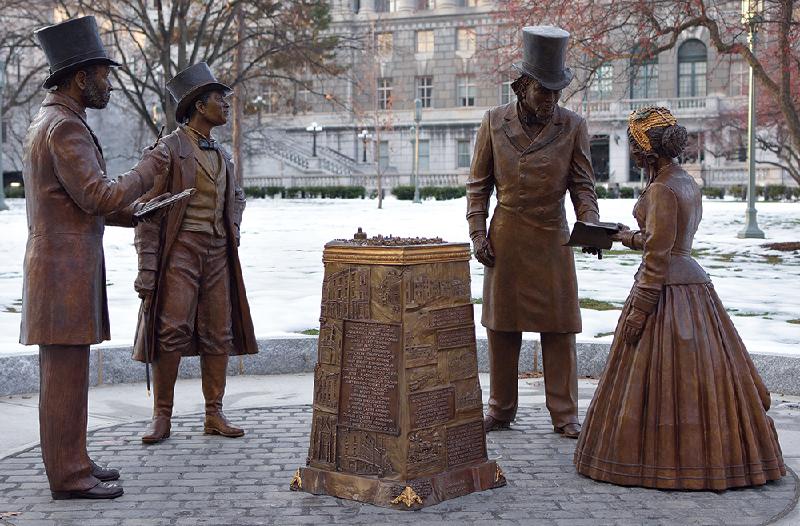
    <summary type="html"><![CDATA[<p><strong><em>In 2020, as communities around the nation took down monuments symbolizing the legacies of American slavery, Harrisburg residents set up a monument to African American history and the power of the vote. </em></strong></p><img src="https://harrisburghistorical.org/files/fullsize/deaad0b9295abae0a1dfa266d3e54656.jpg" alt="A Gathering at the Crossroads" /><br/><p>On August 26, 2020, <em>A Gathering at the Crossroads</em> commemorated the anniversaries of the Fifteenth and Nineteenth  Amendments through the installation of a monument to Harrisburg’s Black history. 150 years after the right to universal male suffrage was granted to the people of the United States, and 100 years after women's suffrage was established, 2020 marked the intersection of the legacies of past achievements, and the inconsistencies and obstacles of the present. Beginning in the Spring of 2020, protests against police brutality toward Black Americans swept the nation, calling attention to continued injustices in American society. </p><p>At the height of this racial reckoning, a new bronze monument was placed on the Irvis Equality Circle, which marks the south <span>lawn of the Speaker K. Leroy Irvis Office Building </span>in Harrisburg’s Capitol Complex. A little more than a century ago, neither the Circle nor the expansive Capitol building existed. The area where this monument now stands was once a part of the Old Eighth Ward known as Tanner’s Alley, a predominantly African American neighborhood. Instead of lush green spaces and domed ceilings, this part of Harrisburg was filled with thriving churches, schools, businesses, and private residences. In the early twentieth century, however, these spaces were torn down and families were forced out of their homes due to the Capitol expansion project. The City Beautiful movement started as a push to create new green spaces and waste disposal measures that would benefit the entire community, but by the 1910s, it had morphed into a drive to complete the Capitol Complex that stands today. The Old Eighth, home to significant Black, Jewish, and immigrant populations, was demolished and residents were forced to relocate. For many years, their names and stories were forgotten. </p><p>The monument at Irvis Equality Circle is, to date, the only monument on the Capitol grounds honoring Harrisburg's Black community. The Commonwealth Monument Project is an initiative of the the International Institute for Peace through Tourism and was led by Lenwood Sloan (Executive Director), Jeb Stuart (Secretary of Logistics and Installation), Kelly Summerford (Treasurer), Phyllis Bennett (Government and Business Liaison), and Valerie Leblanc (Planning and Development). It enjoyed bipartisan support from both the Pennsylvania House of Representatives and Senate, along with major financial contributions from the City of Harrisburg, the Foundation for Enhancing Communities, Peggy Grove, Dauphin County Commissioners, Messiah University, Senator Sharif Street, and many other generous donors. </p><p>Artist Becky Ault and Art Design Group crafted four life-sized bronze statues of African American orators, each of whom made major contributions to the quest for racial justice in America and have a meaningful connection to the city of Harrisburg. These include, from left to right: </p><p>Thomas Morris Chester (1834–1892), a Civil War correspondent and Harrisburg native. In 1863, he became the captain of one of Harrisburg’s Union companies. Through 1864, Chester reported on the war effort, particularly the contributions of African American troops. Most newspapers completely overlooked the African American soldiers, but through Chester’s journalism, papers such as the <em>Philadelphia Press</em> printed information about them. After the war, Chester returned to Harrisburg where he became the secretary of the newly founded Garnet Equal Rights League, which advocated for Black rights and freedoms. This section of Walnut Street is named the "T. Morris Chester Way" in his honor.</p><p>Jacob T. Compton (1836–1905), sergeant in Company D of the 24th United States Colored Infantry (USCT) and local musician. In the Harrisburg community, Compton was known for leading the choirs of both African Methodist Episcopal and African Methodist Episcopal Zion churches, and for founding the Excelsior Band. Compton was also a carriage driver. Among the ranks of his passengers was Abraham Lincoln, soon to be the sixteenth president of the United States. In February 1861, before his inauguration, president-elect Abraham Lincoln visited Harrisburg. When an assassination plot was uncovered, it was Compton who <span>drove the getaway carriage.</span></p><p>The third figure, Reverend William Howard Day (1825–1900), was a prominent educator and orator, and one of America’s most renowned civil rights activists of his time. His contributions to Harrisburg were plentiful. In the 1870s, Day was appointed to the Harrisburg School Board of Directors. He successfully led the board in allocating funds to public schools for new textbooks and blackboards. Day fought for better education for African Americans both by improving the schools that existed for African American students and by beginning the process of integration at Harrisburg’s all-white Boys High School. Day was also an active community leader at the Wesley Union African Methodist Episcopal Zion Church on South Street. </p><p>The final figure on the right is Francis Ellen Watkins Harper (1825–1911), who fought for the abolition of slavery, women’s suffrage, and temperance. This statue of Francis holds the Fifteenth Amendment, which guaranteed universal male suffrage. She is depicted passing the document back to Day, demonstrating that there was still more to do: women were not yet enfranchised. Harper was a renowned antislavery journalist, poet, and public speaker, who gave lectures in cities across the United States, including Harrisburg. One of her most famous speeches, “We Are All Bound Up Together,” expressed the frustrations of Black women at being largely excluded from the women’s suffrage movement and called for universal voting rights.</p><p>These four visionaries surround a pedestal at the center of the monument. A model of the Old Eighth Ward sits on top. A blue star indicates the location of the monument relative to the vanished landscape of the Old Eighth Ward. The sides of the pedestal bear the names of one hundred influential Black residents of Harrisburg. These individuals were freedom seekers, abolitionists, suffragists, church leaders, doctors, businesspeople, poets, and more. All called Harrisburg home, and all fought for a better, more equitable city. </p><p>The impact of the many Black Americans honored by <em>A Gathering at the Crossroads</em> is not confined to this space on Walnut Street. Their legacies are everywhere: in Harrisburg’s school system, churches, cemeteries, and homes. Some of their stories have been explored throughout the “Chester Way” tour. Each location highlights a moment in time when Harrisburg’s residents spoke out against oppressive structures and ushered in radical change in areas of education, politics, and social life. As you reflect on each stop on the tour, you may discover something new about the capital city’s history and find yourself at a different kind of “crossroads,” as the struggles, hopes, and triumphs of the past intersect with the aspirations of the present. </p><p>A full list of the resources used in this story can be found <a href="https://www.zotero.org/groups/5114087/harrisburg_historical/collections/3WI8N8R7/items/7RE3X2J3/collection">here</a>.</p><p><strong>Related Stories:</strong></p><p><a href="https://harrisburghistorical.org/items/show/10">The Second Capitol Extension of Harrisburg, Pennsylvania</a></p><p><a href="https://harrisburghistorical.org/items/show/4">The Lincoln Street School</a></p><p><a href="https://harrisburghistorical.org/items/show/13">Lincoln's Close Call</a></p><p><a href="https://harrisburghistorical.org/items/show/12">It's a Family Business</a></p><p><a href="https://harrisburghistorical.org/items/show/18">Taking the Moose Lodge to Court</a></p><p><em><strong><a href="https://harrisburghistorical.org/items/show/6">For more (including 6 images, 2 audio files,&#32;&amp;&#32;1 video) view the original article</a></strong></em></p>]]></summary>
    <published>2023-11-01T15:40:47+00:00</published>
    <updated>2026-04-17T19:49:02+00:00</updated>
    <link rel="alternate" type="text/html" href="https://harrisburghistorical.org/items/show/6"/>
    <id>https://harrisburghistorical.org/items/show/6</id>
    <author>
      <name>Alexandra Shehigian</name>
    </author>
  </entry>
</feed>