<?xml version="1.0" encoding="UTF-8"?>
<feed xmlns="http://www.w3.org/2005/Atom">
  <title type="text">Harrisburg Historical</title>
  <updated>2026-07-05T18:14:55+00:00</updated>
  <generator uri="http://framework.zend.com" version="1.12.20">Zend_Feed_Writer</generator>
  <link rel="alternate" type="text/html" href="https://harrisburghistorical.org/"/>
  <link rel="self" type="application/atom+xml" href="https://harrisburghistorical.org/items/browse?output=rss2"/>
  <id>https://harrisburghistorical.org/</id>
  <author>
    <name>Harrisburg Historical</name>
    <uri>https://harrisburghistorical.org</uri>
  </author>
  <link rel="hub" href="https://pubsubhubbub.appspot.com/"/>
  <entry>
    <title type="html"><![CDATA[Jacob T. Compton: The Musician, Sergeant, and President&#039;s Coachman ]]></title>
    <summary type="html"><![CDATA[<p><strong><em>On a cold February night in 1861, President-elect Abraham Lincoln, en route to Washington D.C., spent an hour in a carriage with Jacob T. Compton, a notable Black coachman, musician, and liberated man. One went on to serve a contentious but impactful presidential term during the American Civil War; the other became an influential USCT sergeant, musician, activist, organizer, and minister.</em></strong></p><img src="https://harrisburghistorical.org/files/fullsize/a10de33cff77c9e0be01ebdf701e2124.jpg" alt="Jacob T. Compton Statue" /><br/><p>On the night before arriving in Harrisburg, Pennsylvania (February 20, 1861), president-elect Abraham Lincoln received word of an assassination plot planned for his expected journey through Baltimore. Harrisburg resident Simon Cameron, Lincoln's future Secretary of War, entrusted the president's safety to his coachman, Jacob Compton. In a matter of an hour, Compton swiftly escorted Lincoln and his family from their lodgings at the Jones House to a covert train bound for his inauguration in Washington, D.C. The whisking away of Abraham Lincoln was remembered for decades to come.</p><p>Lincoln's escort, Jacob Tilford Compton (Cumpton), was born on August 3, 1836, in Williamsport, Maryland, to Rebecca and Ezekiel Compton. Although his father was enslaved, his mother was free, which gave him the legal status of a Freeman. A year after his parents died of cholera in 1854, Compton left Williamsport after allegations surfaced that he had helped two men, George and John Butler, escape to Harrisburg. He reached Harrisburg, where he spent much of the rest of his life. </p><p>In Pennsylvania's capital city, Compton found employment first in a brickyard, where he once warded off an abduction attempt. Soon he met U.S. Senator Simon Cameron, who hired him as his personal coachman. It was through this connection that Compton later met the president-elect, who was journeying in 1861 from Illinois to Washington, D.C. </p><p>When Lincoln's aides learned of the plot to assassinate Lincoln in Baltimore, they made arrangements for a secret train to carry him to Washington, D.C. Lincoln agreed to the plan but only after honoring his commitment to attend the events planned by Pennsylvania Governor Andrew Curtin. Lincoln’s first stop was the Jones House, a hotel overlooking Market Square (later known as the Commonwealth Hotel), where he gave a speech to the residents of Harrisburg. He then addressed the state legislature at the Pennsylvania Capitol and returned to the Jones House. Although Lincoln had intended to spend the night at the hotel, Governor Curtin, Chicago police detective Allan Pinkerton, and Pennsylvania Senator Simon Cameron devised a plan that allowed the president-elect to make an earlier exit.</p><p>Cameron called on his personal carriage driver, Jacob Compton, to help. Compton drove one of the two carriages that secretly transported Lincoln and Colonel Ellsworth, another man traveling with Lincoln, from the Jones House to a Pennsylvania Railroad station at Second and Vine. According to the <em>Harrisburg</em> <em>Telegraph</em>, Compton would later recall that "all the way to the station Mr. Lincoln protested against the secrecy, ridiculed the idea of great danger and with difficulty was persuaded to be guided by the counsel of his escort." </p><p>Compton is best known today for spiriting the Lincolns out of Harrisburg, but his transport of the presidential family was only a short moment in an influential life that would continue for nearly half a century more. Most notably, Compton enlisted in the 100th Pennsylvania United States Colored Troops on July 18, 1864, and subsequently served as a corporal and then a sergeant for Company D of the 24th Infantry Regiment of the USCT, which guarded the nation's capital. Compton's seventeen months of military service to the Union cause demonstrated his commitment to freedom. Clearly he was proud to serve: he marched in the USCT Grand Review parade on November 13, 1865. </p><p>After the war, Compton remained an active member of Harrisburg’s community. He resided on South Street, two blocks away from the State Capitol, and operated a restaurant at the Bolton Hotel. He was extensively involved in the Bethel African Methodist Episcopal (A.M.E.) Church, a congregation that assisted new voters in registration after the passing of the Fifteenth Amendment in 1870. Compton was also an outstanding musician who played the cornet for the Harrisburg Keystone Band. He assisted with music programs at Bethel A.M.E. Zion Church and starred in Excelsior, Harrisburg’s most popular all-Black musical group. Compton also directed the choirs of the city's A.M.E. Zion churches and taught Sunday school music lessons. He was a prominent member of his local chapter of the Grand United Order of Odd Fellows Friendly Society, a fraternal group that focused on charity and community service; and he served as Trustee of Brotherly Love Lodge #896, which met on Cowden Street in the Eighth Ward.</p><p>During the final ten years of his life, Compton and his wife Lucretia lived in Wilkes-Barre, Pennsylvania, where he worked as a coachman for a local attorney and a doctor. Newspaper reports from the late nineteenth century show him serving in the Bethel A.M.E. Church, singing in the church choir, organizing the Fred Douglass Literary Society, and coordinating a parade for the Odd Fellows.</p><p>Jacob Compton passed away on September 6, 1905, at age sixty-nine. Newspaper articles about him in later years described him as friendly, gentle, curious, and well-regarded by many in Harrisburg and Wilkes-Barre. According to an obituary published in the <em>Harrisburg Telegraph</em>, Compton was one of the city’s oldest Black residents of the time. He was buried in block F of the Lincoln Cemetery, a historically African American cemetery in Harrisburg. Numerous obituaries hailed Compton as a hero who drove Lincoln’s carriage during his escape and recognized his work with musical groups, church communities, the Freemasons, and the United States Colored Troops. Compton’s commitment to civic service, civil rights, and serving his community and country makes him an important historical figure to remember. </p><p>The site of the Jones House itself serves as a living reminder of Compton’s bravery and his assistance to the Lincoln family, signifying the beginning of the escape. While a marker at the site of the Jones House memorializes Lincoln’s flight, it does not mention Compton’s role in transporting the president-elect. Compton's numerous accomplishments demonstrate both his resilience and his selfless service to Harrisburg — traits that should be remembered when memorializing the Old Eighth Ward. The new bronze statue of Jacob Compton in the monument group known as "A Gathering at the Crossroads" offers a fitting legacy to a man who made a local difference, leaving rippling effects across the country.</p><p>A full list of the resources used in this story can be found <a href="https://www.zotero.org/groups/5114087/harrisburg_historical/collections/Z2JMA7JK">here</a>.</p><p><strong>Related Stories</strong></p><p><a href="https://harrisburghistorical.org/items/show/11">Welcome Home USCT</a></p><p><a href="https://harrisburghistorical.org/items/show/6">A Gathering at the Crossroads</a></p><p><a href="https://harrisburghistorical.org/items/show/2">Harrisburg's Lincoln Cemetery</a></p><p><em><strong><a href="https://harrisburghistorical.org/items/show/13">For more (including 3 images&#32;&amp;&#32;2 audio files) view the original article</a></strong></em></p>]]></summary>
    <published>2024-07-16T00:43:45+00:00</published>
    <updated>2026-04-17T19:49:02+00:00</updated>
    <link rel="alternate" type="text/html" href="https://harrisburghistorical.org/items/show/13"/>
    <id>https://harrisburghistorical.org/items/show/13</id>
    <author>
      <name>Kylie Smith</name>
    </author>
  </entry>
  <entry>
    <title type="html"><![CDATA[Fort Couch, Fort Washington, and the Defense of Harrisburg: How Black Civilians, Laborers and Soldiers Helped Defend Pennsylvania&#039;s Capital]]></title>
    <summary type="html"><![CDATA[<p><strong><em>In June 1863, Black and white Union troops and civilians constructed two forts on Hummel Heights, an elevated point on the western bank of the Susquehanna River, to defend against the approaching Confederate troops. Today, the remnants of Fort Couch stand as a testament to the importance of Black soldiers and civilians in the Union’s defense of Pennsylvania.</em></strong></p><img src="https://harrisburghistorical.org/files/fullsize/450039cc3940606c15b28a448bed97d8.jpg" alt="Pennsylvania civilians digging of earthworks on Hummel Heights" /><br/><p><span style="font-weight:400;">In 1863, a fierce Confederate invasion threatened the Pennsylvania capital of Harrisburg. The hot summer sun, frequent rains, and low morale plagued Union forces. Thanks in part to the construction of Fort Couch and Fort Washington, built largely by Black laborers, the rebel invasion was halted, a crucial part of turning the tide against the Confederacy during the Civil War. Equally significant, the inclusion of local Black men in the northern war efforts illustrated substantial progress toward a truly integrated military.</span>
<span style="font-weight:400;">Intending to strike a devastating blow to Union forces, Confederate General Robert E. Lee launched an invasion into northern territory in the summer of 1863. As Lee’s army rapidly approached Harrisburg, the Pennsylvania Capital’s fortifications and Union Militia along the Susquehanna River helped turn the rebels toward Gettysburg. The Confederates’ defeat there resulted in their retreat southward and eventual surrender to Union General Ulysses S. Grant in 1865, marking the end of the Civil War.</span>
<span style="font-weight:400;">But in June 1863, the South’s defeat was far from inevitable. Harrisburg, a vulnerable point in Union defenses, stood as an ideal gateway northward. Capturing the city would give the rebels control over the ports of the Susquehanna River, the railroads, and the defensive points along the River. As the Confederate forces approached, mass evacuations took place leaving the typically busy state capital nearly empty. </span>
<span style="font-weight:400;">To fend off incoming Confederate forces, Union Major General Darius N. Couch ordered the construction of fortifications overlooking the river on Hummel Heights, an elevated point on the west bank of the Susquehanna. He was assisted by Major James Brady, of the Pennsylvania Volunteer Artillery, and Engineer John A. Wilson. The first fortification, named Fort Washington, was built on the bluffs of what is today Lemoyne’s Negley Park. However, as this position was vulnerable to attack from a nearby high point, General Couch called for another fortification half a mile to the west. The second location was the site of Fort Couch, which occupied a higher, more tactically advantageous position.</span>
<span style="font-weight:400;">Construction of Fort Washington began on June 15, 1863. Volunteers eagerly started digging the earthworks, swinging their pickaxes into the topsoil. As the soft ground soon gave way to hard shale, the men began to weary and morale plummeted. By the next morning, after digging through the night by the light of bonfires, many volunteers had quit. In response, William T. Hildrup, superintendent of the Hummel Heights fortifications, placed advertisements in </span><i><span style="font-weight:400;">The Patriot and Union</span></i><span style="font-weight:400;"> directed to white and Black residents. Significantly, he offered equal pay — $1.25 per day — to Blacks. Finding extra men to work on the fortifications was a priority regardless of race. The Pennsylvania Railroad also sent workers, many of whom were African Americans, to complete some of the hardest work. Over six hundred citizens and railroad workers helped build the fortifications.</span>
<span style="font-weight:400;">As the fortifications were being constructed, Pennsylvania Governor Andrew Curtin called for Pennsylvanians to defend their state, issuing an emergency call for volunteer troops on June 15. Men quickly signed up, including a full company of ninety African American men who departed from Philadelphia under white officers just twelve hours after the Governor’s call. But upon arriving in Harrisburg, Major General Couch turned them away, citing that Congress had authorized the enlistment of Black troops only if they were signed up for at least three years — not for emergency militia service. Word of their refusal reached Secretary of War Edwin Stanton, who then ordered Couch, "You are authorized to receive into the service any volunteer troops that may be offered, without regard to color." Privately, however, Stanton told noted abolitionist George Stearns not to send any more Black companies, probably because he feared disharmony at a crucial moment in the city's defense. </span>
<span style="font-weight:400;">In response to the Philadelphian troops’ rejection, Harrisburg's African American community convened a meeting "for the purpose of organizing and offering their services to the Governor." Days later, Harrisburg's first Black company was formed by Henry Bradley, a forty-one-year-old local Black barber. T. Morris Chester, who became the only Black war correspondent during the Civil War, quickly formed a second company, raising their numbers to 120.</span>
<span style="font-weight:400;">On June 26, as Confederate lines spread out across the state, Governor’s General Orders No. 44 was issued. The order, which made no racial distinction, called for “sixty thousand men for the defense of the State, to be mustered into the service of the State, for the period of ninety days, unless sooner discharged.” Bradley’s and Chester’s companies were then equipped with uniforms and equipment, but Harrisburg’s military authorities refused to provide them rifles, even as the Adjutant General ordered that all citizens could be furnished weapons at the city arsenal. The companies nonetheless continued to drill in the streets around the Capitol, patiently waiting for their time to come.</span>
<span style="font-weight:400;">As the troops drilled, construction of the city’s fortifications on Hummel Heights continued steadily. When Couch called Fort Washington complete on June 19, he feared it was threatened by a higher bluff to the west. In response, he ordered the construction of another fort, called Fort Couch in his honor, on the higher ground. Alongside Union troops from Pennsylvania and New York, African American civilians, refugees, and railroad workers once again completed most of the work. They dug day in and day out in heavy rain at the tough clay ground. Though it is unclear if Fort Couch was ever finished, it was nevertheless armed with cannons.</span>
<span style="font-weight:400;">On June 28, with artillery booming in the distance, the crisis reached its apex. Probably owing to false intelligence that the rebels were preparing to cross the river, the two Black companies, who had continued to drill in the streets, were finally permitted to carry arms. They promptly joined the other troops at the fortifications on Hummel Heights to await the Confederate attack.</span>
<span style="font-weight:400;">That attack, however, never came. Though rebels led by General Albert G. Jenkins and his cavalry took Mechanicsburg by June 28 and divisions were ordered towards Harrisburg, advancing Union forces caused Lee to concentrate his troops at Gettysburg. </span>
<span style="font-weight:400;">The defense of Harrisburg is an important event in the city’s African American history, for it marks a moment in which Harrisburg’s African Americans volunteered to defend their home even as they faced discrimination. After Captain Bradley’s company received their weapons from the arsenal, they marched through the Capitol grounds to the admiration of white and Black onlookers. Drilling unarmed in the streets for days, these soldiers, now armed with rifles issued by the State of Pennsylvania, evoked an image of resilience, determination, and agency. During a war in which this agency was threatened, Harrisburg’s African Americans contributed to the fight for their freedom in a variety of ways. From taking up arms to taking up a pickaxe, their actions represented one more step towards equality.</span>
<span style="font-weight:400;">After the war, Fort Washington and Fort Couch fell into neglect and were largely forgotten. Today, nothing remains of them except traces of dug-out breastworks — indications of the people of Harrisburg’s readiness to defend their city.</span>
A full list of the resources used in this story can be found <a href="https://www.zotero.org/groups/5114087/harrisburg_historical/collections/KG5ITEGZ">here</a>.</p><p><strong>Related Stories</strong></p><p><a href="https://harrisburghistorical.org/items/show/11">Welcome Home USCT</a></p><p><em><strong><a href="https://harrisburghistorical.org/items/show/9">For more (including 4 images&#32;&amp;&#32;2 audio files) view the original article</a></strong></em></p>]]></summary>
    <published>2024-02-12T20:31:55+00:00</published>
    <updated>2026-04-17T19:49:02+00:00</updated>
    <link rel="alternate" type="text/html" href="https://harrisburghistorical.org/items/show/9"/>
    <id>https://harrisburghistorical.org/items/show/9</id>
    <author>
      <name>Dominic Gomez</name>
    </author>
  </entry>
  <entry>
    <title type="html"><![CDATA[Harrisburg&#039;s African Methodist Episcopal Churches: The Road to Emancipation]]></title>
    <summary type="html"><![CDATA[<p><strong><em>During the nineteenth century, the African American churches of Harrisburg were much more than houses of worship; they were agents of enfranchisement and liberation.</em></strong></p><img src="https://harrisburghistorical.org/files/fullsize/9448317b18fa8ff935d4157d3f4d961e.jpg" alt="Bethel AME,  Short Street View" /><br/><p>It was January 1, 1863. To many residents of Harrisburg, it was likely just a typical New Year's Day, but to the city's African American community, it held far greater significance as it marked the day the newly passed Emancipation Proclamation took effect. That evening, three chosen men met at the Bethel African Methodist Episcopal (AME) Church on Short Street to write a response to this momentous occasion. Not only did they encapsulate the joy and approval that African Americans felt, but also the anger and frustration that stemmed from two centuries of racial discrimination and dehumanization, warranting such a proclamation in the first place. By the end of that night’s worship service, the response was approved via a vote, simultaneously celebrating a win for African Americans worldwide while also acknowledging that work was far from over — work that Black churches in Harrisburg had already been doing for decades and would continue in the years ahead. 
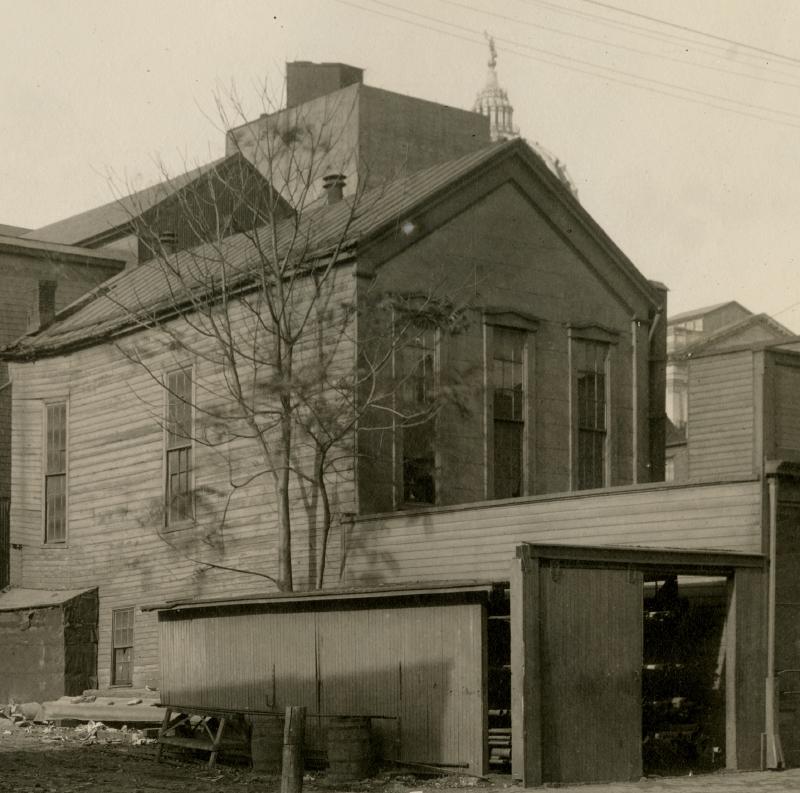
The resolution composed by schoolteacher John Wolf, prominent community member Samuel Bennett, and Reverend David Stevens of the Wesley Union AME Zion Church may have captured what Harrisburg’s African American community felt about slavery, but their actions spoke louder. Despite its small stature, under the leadership of Reverend Mifflin Gibbs, the Bethel AME Church “included many of those who did man's work by day and the Lord's work by night, maintaining an active presence in that shadowy operation known as the Underground Railroad.” Understanding the difficulties that resulted from escaping slavery, the church provided housing for freedom seekers and found them employment in the local coal, iron, and steel industries, helping them settle into their new lives in the North, whether Harrisburg was their final home or merely a stop on the way. Later, following the ratification of the Fifteenth Amendment in 1870, Bethel AME took things a step further by registering new voters and offering classes in civic education, ushering in a new era of voting rights for the city. Although the Short Street church played a crucial role in the antislavery movement and in advancing the rights of African Americans, it was not alone. 
At the corner of Third and Mulberry Streets sat the small log building that housed the Wesley Union Church. Its neighborhood of “Judy’s Town” was a key spot for African American social and spiritual life, so it is unsurprising that it became the first of Harrisburg’s regular Underground Railroad stops, becoming the epicenter of the movement in the city by 1829. As at Bethel AME, many freedom seekers found refuge at Wesley Union, a direct result of the sermons that congregants heard during worship services, filling them with a sense of love and duty that inspired them to put everything on the line to help total strangers. One early Wesley Union congregant, William “Pap” Jones, was known for being one of the most effective Underground Railroad conductors in the area, using his extensive knowledge of northern routes to create guides for freedom seekers. Another congregant, Harriet McClintock Marshall, assisted freedom seekers by providing them with shelter, food, and clothing before ushering them to their next stops on their journeys to freedom; her husband’s status as a formerly enslaved man likely strengthened her resolve to help others on their journeys to freedom.
In fact, Harrisburg’s African American community was participating in Underground Railroad activities long before the Underground Railroad was established. For instance, Reverend David Stevens of Wesley Union Church encouraged his congregation to “strive for self-reliance and community,” a mission they fulfilled by assisting the needy in every way possible. The “needy,” of course, included enslaved people who had escaped from their bonds and were settling in the North. These actions led to the formation of a sort of network that connected different members of the Harrisburg African American community throughout the 1820s and 1830s under a common goal. Stevens and fellow African American minister Jacob D. Richardson publicly denounced slavery and opened the church to anti-slavery meetings and events, even attempting to start their own anti-slavery newspaper — <i>Zion’s Wesleyan Connection </i>— in 1841. The church continued to grow until their small log building in Judy’s Town was no longer big enough, leading founding pastor Stevens to seek out a new location at the corner of Tanner’s Alley and State Street, east of the Capitol building, where the congregation moved in its entirety in 1839. The construction of new buildings on the same site in 1862 and then again in 1894 demonstrates Wesley Union's success throughout the nineteenth century as it continued to flourish in spite of adversity. 
Churches such as Bethel AME and Wesley Union played a pivotal role in organizing Harrisburg’s Underground Railroad. From holding recruitment meetings for Black Civil War regiments to hosting national-scale anti-slavery speakers, houses of worship stood at the forefront of the city’s efforts to resist slavery and to support freedom seekers. Indifferent or discriminatory residents of Harrisburg may have viewed these African American men and women as "radicals" or lawbreakers, but in reality, they were fighting for justice and human dignity as children of God.<b></b></p><p>A full list of the resources used in this story can be found <a href="https://www.zotero.org/groups/5114087/harrisburg_historical/collections/6HAU588N">here</a>.
Related Stories</p><p><a href="https://harrisburghistorical.org/items/show/8">Harrisburg's Role in the Underground Railroad</a></p><p><a href="https://harrisburghistorical.org/items/show/5">Douglass in Harrisburg</a></p><p><a href="https://harrisburghistorical.org/items/show/4">The Lincoln Street School</a></p><p><a href="https://harrisburghistorical.org/items/show/2">Harrisburg's Lincoln Cemetery</a></p><p><em><strong><a href="https://harrisburghistorical.org/items/show/3">For more (including 5 images&#32;&amp;&#32;2 audio files) view the original article</a></strong></em></p>]]></summary>
    <published>2023-10-24T20:35:55+00:00</published>
    <updated>2026-07-05T18:14:55+00:00</updated>
    <link rel="alternate" type="text/html" href="https://harrisburghistorical.org/items/show/3"/>
    <id>https://harrisburghistorical.org/items/show/3</id>
    <author>
      <name>Rachel Petroziello</name>
    </author>
  </entry>
</feed>