<?xml version="1.0" encoding="UTF-8"?>
<feed xmlns="http://www.w3.org/2005/Atom">
  <title type="text">Harrisburg Historical</title>
  <updated>2026-04-17T19:49:02+00:00</updated>
  <generator uri="http://framework.zend.com" version="1.12.20">Zend_Feed_Writer</generator>
  <link rel="alternate" type="text/html" href="https://harrisburghistorical.org/"/>
  <link rel="self" type="application/atom+xml" href="https://harrisburghistorical.org/items/browse?output=rss2"/>
  <id>https://harrisburghistorical.org/</id>
  <author>
    <name>Harrisburg Historical</name>
    <uri>https://harrisburghistorical.org</uri>
  </author>
  <link rel="hub" href="https://pubsubhubbub.appspot.com/"/>
  <entry>
    <title type="html"><![CDATA[The Chester Family Oyster House: Serving up a Legacy of Activism]]></title>
    <summary type="html"><![CDATA[<p><strong><em>Like all great historical figures, the story of Harrisburg's civil right leader, T. Morris Chester, was not created in a vacuum. Chester's parents, George and Jane Chester, and their Oyster House on Market Street, were channels for abolitionism and activism in nineteenth-century Harrisburg and influenced their children to pursue civil rights efforts in the city, state, and country. </em></strong></p><img src="https://harrisburghistorical.org/files/fullsize/7fd1baaad4f690023c642ad574c1a479.jpg" alt="Thomas Morris Chester Historical Marker" /><br/><p><span style="font-weight:400;">On May 11, 1834, a child was born in the second-story apartment above an oyster shop on Market Street. That child was Thomas Morris Chester, who became one of Harrisburg’s most prominent civil rights leaders. Chester is remembered for his role as the United States’s first Black war correspondent, his advocacy for Black citizenship, and many other contributions. Today, Chester is the centerpiece of many Harrisburg initiatives to honor local Black history and advocacy, including this civil rights tour. Chester’s legacy begins with his parents, George and Jane Chester. The Chesters were activists in their own right, as well as the owners and operators of an oyster house that served as a locus of abolitionist activity in the mid-nineteenth century.</span>
<span style="font-weight:400;">The exact location of the Chesters’ oyster house and restaurant is difficult to identify. In the 1840s, the restaurant was situated in the basement of a building that, according to local historian George F. Nagle, “flanked the county property . . . to the east.” This means that the restaurant was in some way connected to the county courthouse of Harrisburg — the very place where Frederick Douglass was egged after giving an abolitionist speech in 1847. Additionally, records indicate that by 1856 the restaurant sat on the corner of Third and Market Streets. Historians believe either that the building in question was one long structure, extending all the way to this corner from the Courthouse property, or that the Chester family relocated to the building on the corner in 1856. This house hosted freedom-seeking people of all kinds. Not only did it function as a social spot for civil rights activists but also as a stop on the Underground Railroad for those escaping slavery.</span>
<span style="font-weight:400;">The house on Market Street belonged to George Chester, the patriarch of the family. Little is known about George. He was born in 1784 and was someone deeply involved in fighting for Black Americans’ civil rights. He was Harrisburg’s only agent of the <em>Liberator</em>, an abolitionist newspaper published by William Lloyd Garrison, which ran from 1831 to 1865 and was the most widely circulated publication of its kind.</span>
<span style="font-weight:400;">It is also known that George was present when a young woman named Jane arrived in York, Pennsylvania, after escaping from enslavement in Maryland. Jane M. Chester, Thomas’s mother, was born into slavery and, according to later accounts, was possibly enslaved four different times before she escaped from Maryland in 1825. Though the journey from Maryland to Pennsylvania may seem like a comparatively small distance, there was no Underground Railroad at this point to aid Jane. To make matters more dire, slavery was still occurring in Pennsylvania at the time, the last recorded case in the state ending in 1847. </span>
<span style="font-weight:400;">Upon arriving in York, she met George Chester, and the two went on to wed and settle in Harrisburg. </span><span style="font-weight:400;">Together, they had twelve children, but only seven survived into adulthood.</span><span style="font-weight:400;"> In Harrisburg, Jane worked with her husband to provide a safe place for freedom seekers and activists. George and Jane capitalized on the relatively lucrative, high-demand business of oystering in order to build a successful life for themselves and to help make it possible for their fellow African American peers to endure. At the time, there was a relative boom in demand for seafood, and working as an oysterman was one of the most profitable jobs a Black man could hold. </span><span style="font-weight:400;">Because of this position of marginal privilege, the Chesters’ restaurant connected many patrons to the abolitionist movement and the fight for civil rights.</span>
<span style="font-weight:400;">Following George’s death in 1859, Jane moved her residence and the catering business to a home she bought on 305 Chestnut Street. It was rare for either women or African Americans to own homes in the city during this time, let alone someone who belonged to both categories. Considered one of the best caterers in Harrisburg, Jane catered more than three hundred wedding ceremonies and cooked for many prominent people in the state capital, including several governors. In short, Jane carried on the family business of serving the community by promoting justice while supplying delicious food.</span>
<span style="font-weight:400;">It is no wonder, then, that Jane passed on to her children her passion for serving the community and fighting for civil rights. After her death, this legacy of Chester hospitality continued as Jane’s daughter, Eliza Zedericks, lived in the Chestnut Street home with her husband into the twentieth century. Like her mother, she utilized the family home to organize and provide hospitality to people traveling through the city. </span>
<span style="font-weight:400;">Tragically, Jane outlived most of her children, dying on March 19, 1894, at age ninety-two. Thomas Morris Chester had passed away just two years earlier on September 30, 1892. However, the pain of burying her beloved children did not stop her from fighting for what she believed in. An obituary in the </span><i><span style="font-weight:400;">Harrisburg Telegraph</span></i><span style="font-weight:400;"> reveals the impact that Jane had on the community amid her continuous struggle for justice:</span>
<p style="padding-left:48px;"><span style="font-weight:400;">During the later years of her life she was in the habit of going about among the business offices and hotels selling her famous home-made taffy, which was always in demand. She was the principal caterer twenty-five years ago and no great feast or fashionable entertainment was complete without her presence and assistance. She was a consistent Christian and had many friends among all classes of citizens. During her life she saw many famous men, and . . . she could relate interesting incidents of the visits of distinguished public men to [Harrisburg].</span>
<span style="font-weight:400;">Jane set an example for her children by hosting, serving, and providing for those fighting for their rights. Significantly, her house served as the epicenter of this. She opened her home to the downtrodden, served the community from her kitchen, and welcomed with open arms those who turned to her. </span>
<span style="font-weight:400;">The Chester family business may have changed locations, but the legacy of the Chester Oyster House remained the same. Currently, Market Street boasts a historical marker where all can pay witness to that legacy that inspired so many to follow in her footsteps in the past, and still has the power to do so today.</span>
</p><p>A full list of the resources used in this story can be found <a href="https://www.zotero.org/groups/5114087/harrisburg_historical/collections/34H3X4IX">here</a>.</p><p><strong>Related Stories</p><a href="https://harrisburghistorical.org/items/show/6">A Gathering at the Crossroads</a></p><p><a href="https://harrisburghistorical.org/items/show/8">Harrisburg's Role in the Underground Railroad</a></p><p><a href="https://harrisburghistorical.org/items/show/11">Welcome Home USCT</a></p><p><em><strong><a href="https://harrisburghistorical.org/items/show/12">For more (including 6 images&#32;&amp;&#32;2 audio files) view the original article</a></strong></em></p>]]></summary>
    <published>2024-07-10T00:16:45+00:00</published>
    <updated>2026-04-17T19:49:02+00:00</updated>
    <link rel="alternate" type="text/html" href="https://harrisburghistorical.org/items/show/12"/>
    <id>https://harrisburghistorical.org/items/show/12</id>
    <author>
      <name>Meredith Gardner</name>
    </author>
  </entry>
  <entry>
    <title type="html"><![CDATA[Douglass at the Dauphin County Courthouse: Abolition and Violence in the State Capital]]></title>
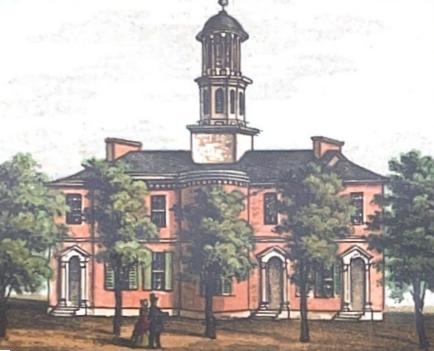
    <summary type="html"><![CDATA[<p><strong><em>In 1847, Frederick Douglass traveled to Harrisburg. The anti-slavery community supported his visit, but his work in the city was overshadowed by a racist mob that attacked him during his speech. Reports of the incident made their way into newspapers across the country, illustrating to many, including Douglass, the North’s role in perpetuating slavery and racism in the United States.</em></strong></p><img src="https://harrisburghistorical.org/files/fullsize/8a578acf7a88b765227c3d3851141026.jpg" alt="Sketching of Dauphin County Court House in 1799" /><br/><p><i>Listen to this story in <a href="https://harrisburghistorical.org/files/show/179" target="_blank" rel="noreferrer noopener">full version</a> or in <a href="https://harrisburghistorical.org/files/show/178" target="_blank" rel="noreferrer noopener">summary</a></i>.<p>In the summer of 1847, two giants of the abolitionist movement, Frederick Douglass and William Lloyd Garrison, toured Pennsylvania to speak at various abolitionist societies and meet other prominent figures in the movement to end the institution of slavery, which had plagued the land for more than two centuries. </p><p>Douglass, the more famous of the two, escaped slavery and went on to become one of the most notable orators, writers, thinkers, and abolitionists of nineteenth-century America. Douglass was an especially charismatic orator, known for his ability to speak and command a stage and to capture the hearts and minds of his audience. Garrison, in contrast, was known as a more timid, introverted man who focused on writing rather than speaking. Both men were controversial even for abolitionists, often causing splits in the anti-slavery camp by criticizing the emigration movement and emphasizing the improvement of the lives of Black people in the United States.</p><p>Douglass's and Garrison’s visit to the capital region came at a time of growing optimism in the anti-slavery cause, when multiple states were passing legislation in support of abolition. Harrisburg itself became a center for the abolitionist movement despite persisting pro-slavery sentiment in the capital. </p><p>On the morning of August 7, 1847, Frederick Douglass and William Garrison arrived in Harrisburg after a difficult train ride during which a belligerent and bigoted man harassed Douglass. Upon their arrival, Douglass and Garrison walked several blocks to the Dauphin County Courthouse, where they were scheduled to speak about their work and the blight of slavery in the country. Garrison spoke for an hour without issue and then gave the floor to Douglass. While the crowd had been very respectful and listened to Garrison’s speech, Douglass was heckled soon after he began speaking, and rabble-rousers threw rotten eggs at him. It didn’t end there. The mob set off fireworks outside; lobbed another volley of eggs toward him, one of which hit Garrison in the back of the head; and shouted racial epithets at Douglass. </p><p>Following this reaction, the abolitionists promptly concluded their speaking engagement. Garrison announced to the people, "Our mission to Harrisburg is ended. If there be not sufficient love of liberty and self-respect in the place, to protect the right of assembly and the freedom of speech, [Douglass] would not degrade himself by attempting to speak under such circumstances, and he would therefore recall the appointment for Sunday night and go where he could be heard." </p><p>As their security escorted Douglass and Garrison out, a mob harassed them while Harrisburg police watched. After the incident, they went to visit some colleagues in the anti-slavery movement at Wesley Union Church, where they received a warmer welcome. At the time, Harrisburg had a sizable free Black population of eleven percent, most of whom created communities around the African Methodist Episcopal and Presbyterian churches. </p><p>The remainder of the tour in Pennsylvania was not as difficult or memorable as their time in Harrisburg. Upon arriving in Pittsburgh on August 9, a notable abolitionist of the area, J.B. Vashon, welcomed them with a brass band. In his speeches, Douglass argued against the institution of slavery, appealing to the people’s religious sensibilities. Mainly, Douglass argued that owning people as property violated the Golden Rule, as well as the democratic principles laid out in the Declaration of Independence. More controversially, Douglass said that the Constitution was a pro-slavery document, which was especially illustrated by the clause stating that runaway slaves should be returned to their enslavers. He also described the North as complicit in keeping slavery alive. Douglass, addressing these pious abolitionists, also railed against the clergymen who defended slavery, calling them hypocrites who dishonored the profession. </p><p>After their speeches, Garrison and Douglass met with Dr. Martin R. Delany, who ultimately helped Douglass finance and establish his publication, the <i>North Star</i>. They later met some other abolitionists in Youngstown, Ohio, and concluded their tour on August 14. The men went their separate ways after that. </p><p>In the end, the intention of Frederick Douglass and William Lloyd Garrison was not to change minds and gain new supporters during their tour of Pennsylvania (as they were largely speaking to established abolitionist societies), but to motivate, inspire, and give direction to abolitionists.</p><p>The work of these men was instrumental to the end of slavery and played a role in the events leading to the Civil War a few years later in 1861. Without them, landmark civil rights legislation such as the Thirteenth, Fourteenth, and Fifteenth Amendments may not have been possible. These changes to the Constitution freed enslaved Americans, made all people equal under the law, and gave all men the right to vote, respectively. </p><p>A full list of the resources for this story can be found <a href="https://www.zotero.org/groups/5114087/harrisburg_historical/collections/HANBHTT2">here</a>.</p><p><strong>Related Stories</p><a href="https://harrisburghistorical.org/items/show/3">Men of God</a></p><p><a href="https://harrisburghistorical.org/items/show/8">Harrisburg's Role in the Underground Railroad</a></p><p><em><strong><a href="https://harrisburghistorical.org/items/show/5">For more (including 3 images&#32;&amp;&#32;2 audio files) view the original article</a></strong></em></p>]]></summary>
    <published>2023-10-26T01:25:15+00:00</published>
    <updated>2026-04-17T19:49:02+00:00</updated>
    <link rel="alternate" type="text/html" href="https://harrisburghistorical.org/items/show/5"/>
    <id>https://harrisburghistorical.org/items/show/5</id>
    <author>
      <name>Dominic Gomez</name>
    </author>
  </entry>
</feed>