<?xml version="1.0" encoding="UTF-8"?>
<feed xmlns="http://www.w3.org/2005/Atom">
  <title type="text">Harrisburg Historical</title>
  <updated>2026-09-25T22:02:52+00:00</updated>
  <generator uri="http://framework.zend.com" version="1.12.20">Zend_Feed_Writer</generator>
  <link rel="alternate" type="text/html" href="https://harrisburghistorical.org/"/>
  <link rel="self" type="application/atom+xml" href="https://harrisburghistorical.org/items/browse?output=rss2"/>
  <id>https://harrisburghistorical.org/</id>
  <author>
    <name>Harrisburg Historical</name>
    <uri>https://harrisburghistorical.org</uri>
  </author>
  <link rel="hub" href="https://pubsubhubbub.appspot.com/"/>
  <entry>
    <title type="html"><![CDATA[Restrictions on Locust Street: Building Homes to Build Fences]]></title>
    <summary type="html"><![CDATA[<p><strong><em>In the 1920s and 1930s, communities of Harrisburg and its surrounding boroughs and townships increasingly limited access of African American and immigrant residents to settle in specific neighborhoods. These restrictive covenants, common throughout the capital region, created channels of segregation with long legacies.</em></strong></p><img src="https://harrisburghistorical.org/files/fullsize/df2ef035724adb6db6f753aef8a470de.jpg" alt="HOLC Zoning Map of Harrisburg" /><br/><p>"It is a part of the consideration hereof, that the grantee, his heirs, executors, administrators or assigns, or his successors in title, shall not sell or lease to any but the Caucasian race." So stated the housing contract made between two Harrisburg citizens in November of 1926 concerning a property on Locust Street south of the capitol. As part of an official sale, this clause contains a restriction that limits the occupants of said property indefinitely to white buyers only. Racially restrictive covenants like this began to appear in Harrisburg and surrounding suburbs during the 1920s and, by the late 1930s, were common in cities across the nation. At a time when pre-existing racial divisions drew distinctive lines between neighborhoods, restrictive housing covenants of this kind were employed to ensure these lines were impassable for non-whites.
Restrictions in the deeds of sale of American homes and property were nothing new in the 1930s. Dating back at least to the early 19th century, property owners and developers used restrictive covenants—legal provisions in deeds that limited how property could be used, developed, or transferred—to bind buyers and even future owners to certain conditions of property usage. A deed might regulate fences, building setbacks, construction materials, or allowable uses of the property. Racial restrictions were a later form of this legal mechanism that worked to regulate the race of those who could own, lease, or occupy a property.
The Locust Street covenant was located in Harrisburg’s Third Ward near the riverfront on a brief stretch of road connecting Front Street to Third Street. In the 1920s, this area included mixed residential housing, businesses, churches, and community centers such as the Young Men’s Christian Association. However, it also lay in close proximity to the railroad and other industrial factories. Ward Three had a population of 88.5% white and 5.7% Black in 1920, but by 1935 had only 68% native white and 8.9% Black. That same year the population was described as “Capitol employees and transients in rooming houses.” With a slowly growing population of immigrants, industrial workers, and other non-whites pressing up against wealthier Front Street residents, Locust Street became a connector between two worlds: one predominantly white upper-middle class and the other an increasingly non-white working class of Wards Three and Four.
The Locust Street property was on the very edge of the white area and had been sold with a racially restrictive covenant in 1923. In other examples of racially restrictive covenants from this time, the restriction appears in a list with other stipulations such as fence length, size of yard, and types of trees allowed to be planted. When this property was resold in 1926, however, the racial clause was the only restriction in the contract. Since it sat on the border between white and Black neighborhoods, this property acted as a fence. The Locust Street deed is an early example of how racial restrictions were utilized in individual contracts as an obstacle to African Americans who wished to cross color lines. This contract, in fact, predates by roughly nine years a nationwide movement to create similar long-lasting barriers for African American home buyers, suggesting that local property owners and real-estate actors were already constructing racial barriers before federal housing policy systematized these practices in the 1930s
Restrictive covenantal language increased after 1935 when, under President Franklin Roosevelt’s New Deal, the Home Owners Loan Corporation (HOLC) was created (Rothstein, <i>The Color of Law</i>, 2017). In conjunction with the Federal Housing Association (FHA), the HOLC evaluated insurable zones in cities across the country and issued mortgages that included both principal and interest in payments. This enabled poorer Americans in areas of low insurance risk to purchase housing and accrue equity.
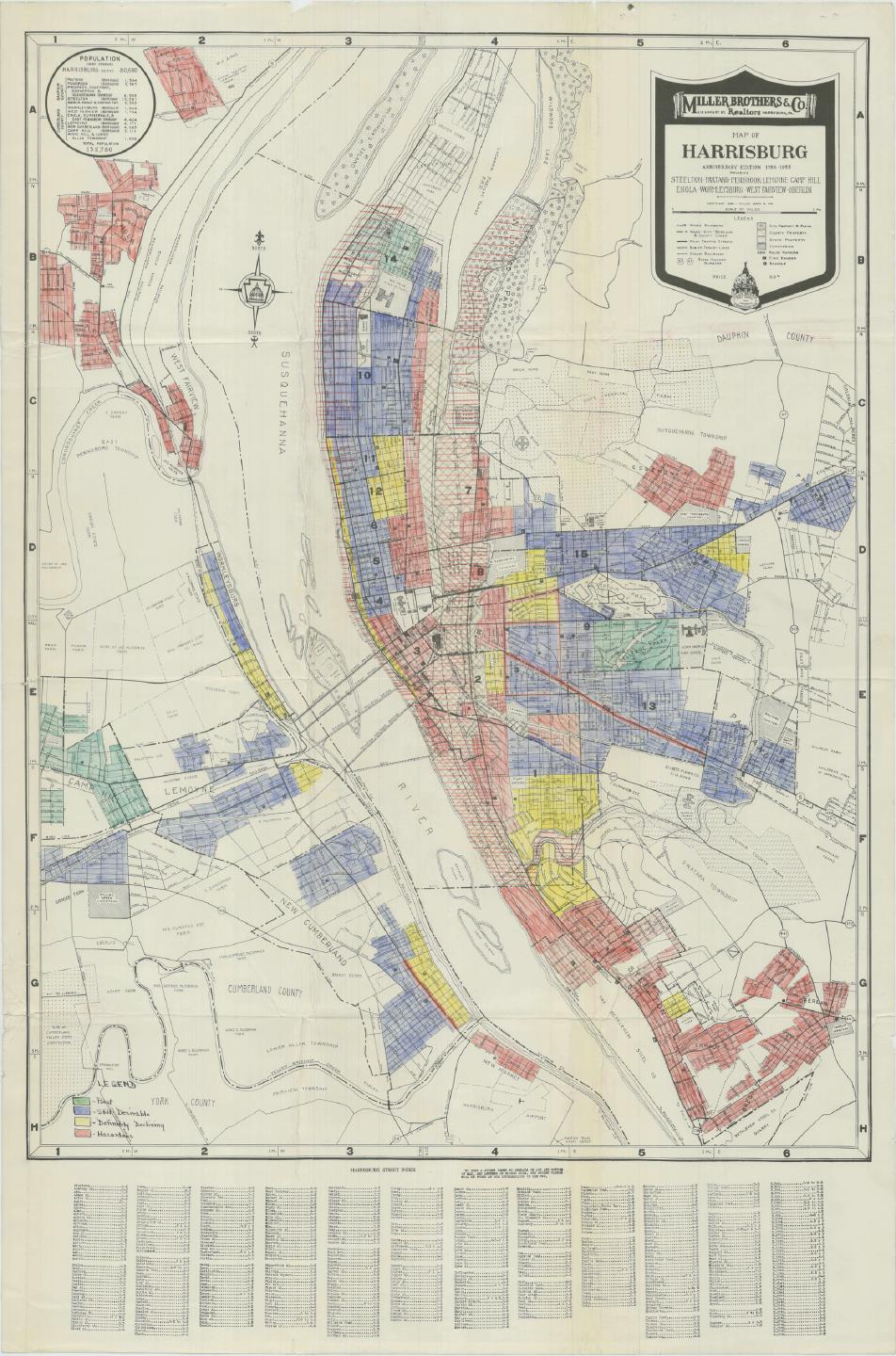
The HOLC outsourced its loan risk evaluations to local real estate agents who surveyed their home city and created a risk map for each neighborhood. Color ratings were given to each area based on factors such as population type, amount of commercial and industry areas, home conditions, possibility of new construction, and “detrimental influences” such as “less desirable elements of the population.” These less desirable elements were usually cited as, but not limited to, “foreigners,” “negro and alien,” and “less desirable native whites.” Grades of risk included green (“best”), blue (“static”), yellow (“definitely declining”), and red (“hazardous”). Given authority to determine which neighborhoods were worthy of investment, these local agents had legal power to devalue existing non-white neighborhoods that they deemed “undesirable.” This process is now known as “redlining,” referring to the red color given to “hazardous” neighborhoods on the HOLC maps.
In Harrisburg, the work of assigning HOLC risk grades was carried out by five local real-estate professionals who were themselves active participants in the city’s housing market. Some of them clearly stood to benefit from redlining. William Nelson and William Hollinger, for example, had been in the process of creating new suburban developments just outside of the central city in the mid-1930s. Even as their surveys devalued the neighborhoods in the heart of Harrisburg, they attracted white citizens to their more expensive developments, which excluded Black buyers and sometimes non-native whites. They achieved this in two ways: high pricing and restrictive covenants. An advertisement for Hollinger’s development in Woodland Park in Paxton township lists house prices starting at $8000 ($188,420.90 today)—a sharp contrast with the housing costs of redlined working-class neighborhoods such as Wards Seven and Eight, which were $800–$2,500 ($18,842.09–$58,881.53 today). The advertisement for this development emphasizes that buyers could easily apply for FHA loans to finance a property. Residents of redlined, high-risk wards such as Seven and Eight, however, were unlikely to receive comparable loans.
Although the price of housing was not itself a direct deterrent to African American home buyers, restrictive housing covenants effectively segregated new communities from the rest of the city. Hollinger Realty Co. and Nelson Investment and Development Corporation marketed suburban developments as a haven for middle and upper-class whites; through carefully placed racial restrictions, they were able to ensure this exclusivity. Colonial Park in Susquehanna, which began construction in 1936, has twelve (known) restrictive covenants. Nelson’s company issued nine known covenants and Hollinger’s issued at least twenty, all in new suburban communities or on borders between higher-rated communities and their redlined neighbors.
Some sixty discovered covenants in Harrisburg seem to lie on borders between a higher and lower-ranked neighborhood or in clusters within suburban developments. For example, there were at least four covenants in the central city that sit on borders between majority white (shown in blue/yellow) and majority African American (shown in red) communities. Suburban neighborhoods surrounding the city tended to have large clusters of restrictive covenants: dense clusters existed in areas like Lower Paxton Township, Progress Township, and Camp Hill. In this way, racially restrictive covenants became a border surrounding white suburbia that was nearly impassable to African Americans and non-native whites living in lower-income areas.
Racially restrictive covenants became unenforceable after the Supreme Court's Shelley vs. Kraemer decision (1948), and the Fair Housing Act of 1968 made racially restrictive covenants illegal more broadly. These acts, however, did nothing to retroactively repair the divisions covenants created. Maude Coleman, an Interracial Board and Pennsylvania Department of Welfare member, had been displaced twice because of Capitol extension projects, and her community north of the Capitol Park was at risk of being destroyed again. She <a href="https://harrisburghistorical.org/files/show/28">wrote to the Pennsylvania governor</a> in 1950 saying, “Our position, Governor Duff, is not like that of other groups. It is absolutely impossible for us to rent or buy property in Harrisburg in any decent neighborhood because of all kinds of restrictions. Certain districts are designated zones for Negroes, and there seems to be an unwritten law against them living anywhere else.” Though people such as Coleman lobbied for more equal treatment within the housing market, Harrisburg’s opportunities for home ownership continued to bleed into the outskirts while barricading the center.
The selling party on Locust Street in this case may not have been aware of the greater movement they participated in, but racially restrictive housing covenants like theirs perpetuated a systemic gap in access to decent housing and, by extension, generational wealth between white and Black residents. As recently as 2002, African American residents in the capital area reported that realtors discouraged them from purchasing property on the western shore of the Susquehanna, which historically hosted several racially restrictive neighborhoods (Loewen, <i>Sundown Towns,</i> 2018). At the same time, the most impoverished areas of the city align with the same areas deemed “undesirable” nearly 100 years ago by the HOLC maps. Restrictive covenants were not the sole factor that limited African American movement within and outside of Harrisburg, but clearly acted as legal fences, inhibiting Black social and physical advancement.
A full list of resources used in this story can be found <a href="https://www.zotero.org/groups/5114087/harrisburg_historical/collections/5CNEH4GC/collection">here</a>.</p><p><em><strong><a href="https://harrisburghistorical.org/items/show/35">For more (including 5 images) view the original article</a></strong></em></p>]]></summary>
    <published>2026-04-19T02:31:38+00:00</published>
    <updated>2026-09-25T22:02:52+00:00</updated>
    <link rel="alternate" type="text/html" href="https://harrisburghistorical.org/items/show/35"/>
    <id>https://harrisburghistorical.org/items/show/35</id>
    <author>
      <name>Molly Elspas</name>
    </author>
  </entry>
  <entry>
    <title type="html"><![CDATA[The Phyllis Wheatley YWCA : Black Women Activists of Twentieth-Century Harrisburg]]></title>
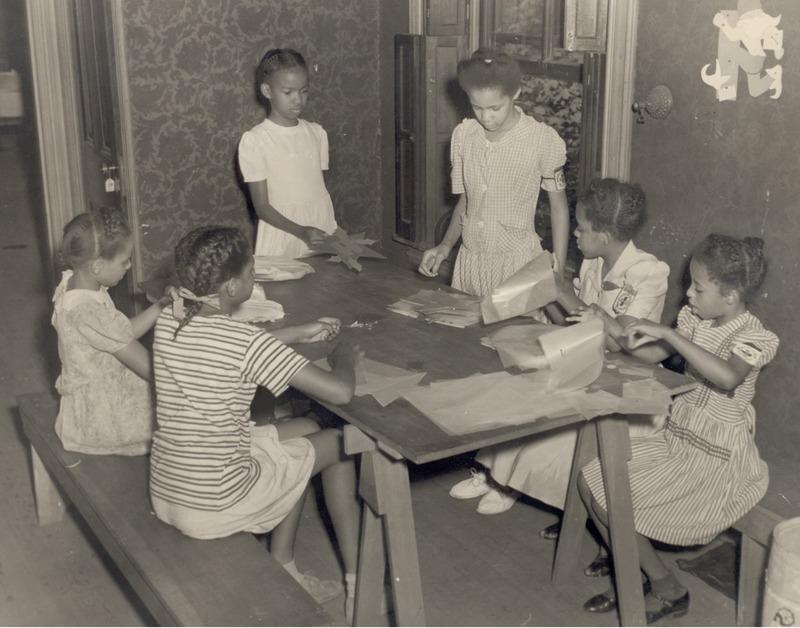
    <summary type="html"><![CDATA[<p><strong><em>The Young Women’s Christian Association, or YWCA, has been active in Harrisburg since 1894. The organization offered language and dance classes, as well as affordable housing, to local (white) women. In 1920, the Phyllis Wheatley branch of the YWCA was opened in Harrisburg. Named after the famous African American poet, the Phyllis Wheatley branch was dedicated specifically to addressing the needs of Harrisburg’s Black women.</em></strong></p><img src="https://harrisburghistorical.org/files/fullsize/ef1615c4569c9fb0dc6ae34487fc9610.jpg" alt="Children at Harrisburg YWCA&#039;s Phyllis Wheatley Branch" /><br/><p>On Cowden and Briggs, a street corner that no longer exists, stood the Odd Fellows building, owned by the Odd Fellows Fraternal Order, with a large room that served as the Phyllis Wheatley branch of the Young Women’s Christian Association. Next door sat a house owned by the YWCA with sleeping facilities available for the women. The YWCA, and nearby YMCA, represented a primary social center of the Black community in the 1920s and 1930s, hosting concerts, clubs, and events available to the local children and adults. <p>The Phyllis Wheatley Branch of the nationwide YWCA was organized in Harrisburg, Pennsylvania, on April 1, 1920, at a time when the social and civic lives of Black and white residents were sharply divided and segregated. The Phyllis Wheatley branch began with 123 members, a number that would flourish as the community took advantage of the resources and programs offered. The Phyllis Wheatley branch, alongside the Forster Street YMCA, was formed from the War Camp Community Service that had provided for World War I soldiers. According to news editor Joe McClure, the Harrisburg YWCA was dedicated to the “recreational, educational, social and religious development of Black women and girls.” The Phyllis Wheatley YWCA branch was a center for solidarity and camaraderie, serving as a safe haven for many Black women. The YWCA helped the region’s Black community combat white nationalism, promote activism, and provide a place for youth through its after-school programs. </p><p>The Phyllis Wheatley YWCA was a refuge with educational programs, home assistance, and spaces for women to be cared for and respected. The branch was named after Phyllis Wheatley, the famous Black poet (1753–1784) who wrote of the challenges she faced during her enslavement. The Phyllis Wheatley branch was named in her honor due to her inspiration for the Black community and the YWCA’s mission of empowerment.</p><p>The Phyllis Wheatley branch developed under the direction of numerous influential leaders throughout the twentieth century, the primary being Mrs. Maude Coleman (1882–1954). Maude B. Deering Coleman, married to John W. Coleman, was born in Virginia but fled the South, becoming a waitress in Harrisburg before the couple moved to Seattle, from 1911 to 1919. During her time in Seattle, Coleman gained significant experience with the YWCA and its role in political and social service. She reportedly received social work training from the University of Washington before they returned to Pennsylvania. According to historian Carrie Streeter, Coleman’s experience and training in Seattle allowed her “to secure a position as the first executive secretary of Harrisburg’s newly opened Phyllis Wheatley YWCA." Once there, she created basketball teams and gymnastics classes for young girls, formed a storytelling club, and, Streeter notes, “arranged for a local lawyer to teach classes in citizenship, a move that coincided with women’s newly ratified right to vote." Coleman wanted to provide safety to women within the Harrisburg community and fought to combat racial discrimination and promote resilience. Coleman was recognized for her service through her appointment as a special representative of the Pennsylvania Department of Welfare in 1924 by Governor Gifford Pinchot (s. 1923–1927; 1931–1935). </p><p>Another influential woman, Ella Frazier (1886–1977), came to Harrisburg in 1923 and became the second executive director of the YWCA Phyllis Wheatley branch. Frazier entered neighboring communities, promoting the YWCA to any young woman she could find. She encouraged young women to become involved in “productive activities” emphasizing etiquette and skills that would provide employment opportunities for women. Mr. Quann, a member of the YMCA, remembered Ella Frazier as “the driving force behind the YWCA” and said, “she kept that organization going and going and going." Ella Frazier was an impactful member of the YWCA, driven to support and assist as many young women in the community as possible, dedicating thirty-two years to the YWCA mission before retiring in 1955. </p><p>The Phyllis Wheatley YWCA was a prominent feature in the Harrisburg community that impacted its members through the attention given to educational, social, and political aspects of life. An announcement published on January 14, 1930, in <i>The Evening News</i>, a local newspaper, lists classes the YWCA offered to the community including sewing, gymnasium, glee club, piano class, arts and crafts, Bible study class, and home nursing. Additionally, the YWCA hosted events throughout the year including an annual Christmas dinner and program and a “Hanging of the Greens” for younger groups to celebrate the Christmas season. One highlight of the social events was the formal dance hosted by the Phyllis Wheatley YWCA and the Forster Street YMCA. Mr. Robert Quann, a Harrisburg resident in the 1920s, reflected on the formal dances where “you always gave your girl a corsage, you just had to do that and you had to wear a boutonniere . . . and you just couldn’t be dressed wrong, not for that.” The YWCA and YMCA were committed to supporting the lives of their community and providing opportunities for people to improve all aspects of their lives.</p><p>Frazier’s retirement coincided with the relocation of the Phyllis Wheatley branch to the main branch, after the original building was demolished in 1954 along with Maude Coleman’s home as part of the Second Capitol Extension. In an effort to make more space for the Capitol Complex, the state government repossessed buildings, including residences and community centers, against the protests of Harrisburg citizens and organizations. The Health and Welfare building was added in the 1950s where the Odd Fellows Hall once stood after its forced seizure. </p><p>Today, the YWCA serves the area with a focus on “economic development, veterans services and violence prevention,” and committed itself to a core mission “to empower women and eliminate racism.” Additionally, the YWCA aims to help victims of human trafficking through grant funding from the United States Department of Justice. U.S. Attorney David J. Freed wrote about the YWCA: </p><p>“Over the course of my career in public service, I have had the opportunity to work together with the dedicated staff at the YWCA of Harrisburg on behalf of victims of Domestic Violence, Sexual Assault, Human Trafficking and Stalking . . . With a small staff and a limited budget, the YWCA provides direct services and advocacy to some of our most vulnerable citizens.”</p><p>Because of the dedication and hard work of the founders, leaders, and organization members, the YWCA of Greater Harrisburg has created a lasting impact on the Pennsylvania community and continues to honor Phyllis Wheatley and her inspiring legacy. </p><p>A full list of the resources used in this story can be found <a href="https://www.zotero.org/groups/5114087/harrisburg_historical/collections/7WPRB7FC">here</a>.</p><p><strong>Related Stories</b></p><p><a href="https://harrisburghistorical.org/items/show/10">The Second Capitol Extension of Harrisburg, Pennsylvania</a></p><p><a href="https://harrisburghistorical.org/items/show/19" target="_blank" rel="noreferrer noopener">The Rowland Beauty School</a></p><p><em><strong><a href="https://harrisburghistorical.org/items/show/17">For more (including 5 images&#32;&amp;&#32;2 audio files) view the original article</a></strong></em></p>]]></summary>
    <published>2024-07-20T13:54:54+00:00</published>
    <updated>2026-04-17T19:49:02+00:00</updated>
    <link rel="alternate" type="text/html" href="https://harrisburghistorical.org/items/show/17"/>
    <id>https://harrisburghistorical.org/items/show/17</id>
    <author>
      <name>Elizabeth Movinsky&amp;#32;&amp;amp;&amp;#32;Sarah Meeks</name>
    </author>
  </entry>
</feed>