<?xml version="1.0" encoding="UTF-8"?>
<feed xmlns="http://www.w3.org/2005/Atom">
  <title type="text">Harrisburg Historical</title>
  <updated>2026-04-17T19:49:02+00:00</updated>
  <generator uri="http://framework.zend.com" version="1.12.20">Zend_Feed_Writer</generator>
  <link rel="alternate" type="text/html" href="https://harrisburghistorical.org/"/>
  <link rel="self" type="application/atom+xml" href="https://harrisburghistorical.org/items/browse?output=rss2"/>
  <id>https://harrisburghistorical.org/</id>
  <author>
    <name>Harrisburg Historical</name>
    <uri>https://harrisburghistorical.org</uri>
  </author>
  <link rel="hub" href="https://pubsubhubbub.appspot.com/"/>
  <entry>
    <title type="html"><![CDATA[Black Politics and City Beautiful: Dr. William H.C. Jones and the Eighth Ward]]></title>
    <summary type="html"><![CDATA[<p><strong><em>During a time when African American voices were rarely heard, Dr. Jones convinced Black residents of Harrisburg to offer their needed support to the City Beautiful movement.</em></strong></p><img src="https://harrisburghistorical.org/files/fullsize/e4b3b21d149e137327393a2c9dd00a8a.jpg" alt="Dr. William H.C. Jones" /><br/><p>On December 20, 1900, Mira Lloyd Dock gave a presentation before the Harrisburg Board of Trade with nearly one hundred slides comparing Harrisburg’s badly maintained riverfront with those of some well-kept cities in Europe. She argued that Harrisburg had the space and natural resources to be sanitary and beautiful if the city put in the effort. Her speech sparked the City Beautiful movement that spanned 1901 to 1915 and resulted in a new capitol building, street and sewage improvements, and additional parks and playgrounds. To do all that, Dock needed support from the Board and Harrisburg’s communities. As a member of the Board of Trade, Dr. William H.C. Jones, Jr. was at Dock’s speech and became the only Black member of the Municipal League for Civic Improvement, a group organized in May 1901 to drive the movement. The League needed the support of the Eighth Ward where Jones lived, so he used his respectability to influence the large African American and immigrant populations there to endorse the beautification of Harrisburg.<p>Dr. William H.C. Jones, Jr. was born in 1860 in Snow Hill, Maryland, to William H. and Esther Jones. He studied medicine at Howard University and the New York Polyclinic Institute before moving to the Eighth Ward of Harrisburg in September 1887. He was a highly respected medical professional and played an active role in a variety of Harrisburg communities with both Black and white residents, especially those in the Eighth Ward. A generous man, he donated to poor houses, flood survivors, and John Harris’s Memorial.</p><p>One of his obituaries described him as someone who was “active in the advancement of Harrisburg, and [prominent] in professional and business life.” Indeed, he was appointed to a juvenile court board of inquiry in 1902 and elected as a School Board Director representing the Eighth Ward from 1902 to 1904. He was president of the Baker Building and Loan Association and a member of the John Harris Memorial Committee. He served as a common councilman for the Eighth Ward and the medical examiner of Brotherly Love Lodge, No. 896, Grand United Order of Odd Fellows. Professionally, he was a member of the American Medical Association and the Pennsylvania State Medical Society, a charter member of the Harrisburg Academy of Medicine, and the only Black man to serve as president of the Dauphin County Medical Society.</p><p>Deeply involved in the communities of Harrisburg, Jones championed the City Beautiful movement from 1901 until his death on January 19, 1905. He wanted to convince the African American community in the Eighth Ward that improving the city would bring much-needed changes to the city. The Eighth Ward was not only one of the most densely populated areas of the city, but the primary neighborhood for African American residents; white populations of lower socio-economic status; and immigrants from Hungary, Italy, Greece, and the Russian-occupied territories, among others. Jones, along with several others in the ward, pushed the neighborhood to support the improvements. Due to his strong relationships and influence in the community, he was able to use his medical knowledge and leadership to help gather support for the city improvement project.</p><p>The committee appointed by the Board of Trade in 1901 was tasked with organizing a mass meeting of citizens to discuss how to improve Harrisburg. As an original member of this group, Jones presided over meetings within the Eighth Ward. He led the first meeting that occurred at the Wesleyan African Methodist Episcopal Church on January 31, 1902, just before the city-wide vote to decide on the changes proposed by the Harrisburg City Municipal League. Newspapers, including the <i>Harrisburg Patriot</i>, noted hundreds in attendance. Jones and other notable leaders spoke at the gathering, including Reverend F. H. Hill, the pastor of the church; Spencer C. Gilbert, a board member for Public Works; and J. Horace McFarland, a key architect of the City Beautiful movement. All of these speakers emphasized their desire for change, progress, and overall beautification of the city. They also included demonstrations emphasizing health benefits and plans for cleanliness, two major driving forces for the movement.</p><p>Since companies had been dumping sewage waste into the Susquehanna River for several years, Jones was convinced that informing residents about its connection with disease would help gather support to clean it up. By conserving Paxton Creek and the banks of the Susquehanna River, Jones believed that residents of the whole city would benefit physically from the sanitized water. Similarly, parks would beautify the city while providing clean places to be outside. During the time that Jones served as president of the Dauphin County Medical Society, the organization recommended specific quarantine periods for diphtheria and scarlet fever to the sanitary committee. At the same meeting, other groups addressed sites for parks, the installation of sewers, and the addition of more telephone lines in the city. Jones continually argued for better sanitation, while he worked to gather support and money for the movement in the Eighth Ward. As a resident of the ward and the only Black member of the Municipal League for Civic Improvement, Jones had a unique opportunity to shape conversations surrounding the ward and the movement.</p><p>The neighborhood of the Eighth Ward was an ethnically diverse community within Harrisburg City. While representation was poor and many voices of the African American community were left out of the decision-making process, prominent leaders like Jones led the community to support the movement. Jones’s main influence was in the first precinct of the Eighth Ward, the southernmost district where many African Americans resided. This precinct voted overwhelmingly in favor of improvements in 1902. Of the 272 votes recorded for the bond issue that year, 261 voted in favor of improvement. This 96 percent acceptance rate was the highest of any of Harrisburg’s precincts. Jones’s efforts created a tentative bond of trust between residents of the Eighth Ward and city leadership looking to build a stronger capital city.</p><p>On the morning of January 19, 1905, Dr. William Harrison Jones, Jr. tragically died, at age forty-four, from double pneumonia after a fall down the Capitol building's steps weakened his body. His fiancé, Margaret Lewis, was at his side when he passed away. Many prominent citizens spoke at his funeral, including Dr. Charles H. Crampton, the future deputy secretary of the State Health Department; Thomas McDowell Jones, an associate editor of the <i>Harrisburg Daily Telegraph;</i> and Benjamin Matthias Nead, a lawyer and politician. The eulogies they gave commended Jones as a businessman, physician, Christian, citizen, philanthropist, and educator. After this untimely loss, the community commemorated his life with the Dr. William Harrison Jones Memorial Entrance and Fountain to a 12th Street playground in 1915. An automobile parade celebrating fifteen years of public improvements in Harrisburg included the dedication of the memorial entrance. This allowed people to formally recognize Jones’s contributions to the City Beautiful movement as a talented doctor and dedicated leader.</p><p>A full list of the resources used in this story can be found <a href="https://www.zotero.org/groups/5114087/harrisburg_historical/collections/P2BGENTE">here</a>.</p><p><strong>Related Stories</b></p><p><a href="https://harrisburghistorical.org/items/show/10">The Second Capitol Extension of Harrisburg, Pennsylvania</a></p><p><em><strong><a href="https://harrisburghistorical.org/items/show/15">For more (including 7 images&#32;&amp;&#32;2 audio files) view the original article</a></strong></em></p>]]></summary>
    <published>2024-07-20T13:51:08+00:00</published>
    <updated>2026-04-17T19:49:02+00:00</updated>
    <link rel="alternate" type="text/html" href="https://harrisburghistorical.org/items/show/15"/>
    <id>https://harrisburghistorical.org/items/show/15</id>
    <author>
      <name>Kyle Shively&amp;#32;&amp;amp;&amp;#32;Emmy Varner</name>
    </author>
  </entry>
  <entry>
    <title type="html"><![CDATA[Maude Coleman and the Case Against Harrisburg&#039;s Second Capitol Extension : The Defense of the Seventh Ward ]]></title>
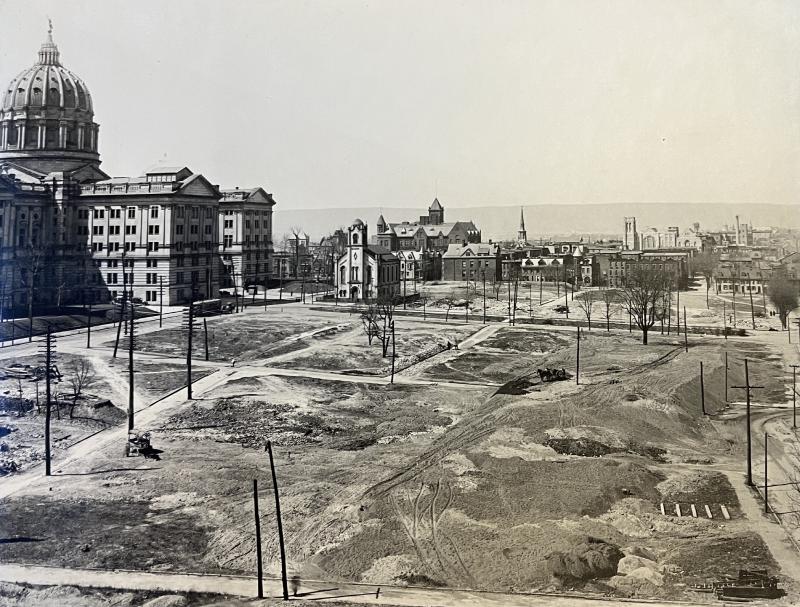
    <summary type="html"><![CDATA[<p><strong><em>In 1950, the prominent Maude Coleman, Interracial Consultant for the Commonwealth of Pennsylvania, wrote a letter to Governor James Henderson Duff advocating for the rights of Black homeowners of the Seventh Ward. In it, Coleman continued her fight to combat the state's seizure of property in her neighborhood.</em></strong></p><img src="https://harrisburghistorical.org/files/fullsize/7ee4dec21fd47f765423d3bfb6630a06.jpg" alt="Walnut and Short Looking North Toward Capitol, January 4, 1918" /><br/><p>In the first half of the twentieth century, during a time of radical change and social upheaval following the Reconstruction period, urban African American communities found themselves at a crossroads of uncertainty. The multiethnic neighborhoods east and northeast of the Pennsylvania State Capitol Building had faced similar circumstances through the First and Second Capitol Extension Projects carried out by the State legislature between the 1910s and 1950s. Those living in these neighborhoods did not capitulate without a fight, with one individual in particular, a community organizer named Maude Coleman, publicly writing to the state governor to affirm the value of her home and those of her neighbors. The letter to the Second Capitol Extension project renewed awareness of the unjust seizure of property in the diverse communities within the City of Harrisburg. </p><p>The appropriation of neighborhoods for the construction of Pennsylvania government buildings took place during multiple decades, beginning in the early twentieth century. North Street formed the divider between the destruction of properties in the "First Capitol Extension" and the "Second Capitol Extension." The first extension was passed by an act of the Pennsylvania Assembly in 1911 and claimed the section of the Old Eighth Ward defined by today's Walnut Street, Seventh Street, North Street, and Commonwealth Avenue. The Capitol Park Extension Commission invested thirty-six million dollars post-1913 to demolish twenty-nine acres (and 538 buildings) east of the Capitol building to create new state government buildings and recreational land by the early 1930s. In 1941, the Capitol Grounds Extension Planning Committee led by J. Horace McFarland outlined a proposal for a second extension and the acquisition of twenty-three more acres between North Street and Forster Street, from Third to Seventh Street across the northeastern corner of the Fourth Ward, and most of what remained of the Old Eighth Ward. This area contained 334 properties with 176 specific owners and a sizable residential population, of whom 50 percent were African Americans. Further extensions in the 1950s claimed neighborhoods north of Forster Street in the southern part of Harrisburg's Seventh Ward.</p><p>It was not uncommon for local, state, or federal officials to factor in race for urban planning efforts during the early to mid-twentieth century. Often, city planners applied generalized stereotypes of poor living conditions in diverse communities to accomplish their goals. In the case of the communities outlined for the initial phase of the Second Extension, the 1935–1936 Home Owners’ Loan Corporation survey noted that the homes between Third and Sixth Street possessed “considerable new paint and good exteriors” as opposed to remaining sections of the Old Eighth Ward to the east which was “run down [and] neglected” and was occupied by “alien white, negroes, and less desirable native whites.” In the planning report, these supposedly run-down homes were labeled as fire hazards (27 percent), with around 30 percent having outdoor plumbing. The planners also outlined other reasons to justify why the location should be purchased, including the improvement and widening of roads to ease traffic and to replace substandard buildings with favorable land for future construction projects. </p><p>The report prepared by the Capitol Grounds Extension Planning Committee was expansive, covering the usability of the extension area; the status and quality of its buildings and owners; the cost factors relating to how properties were to be acquired; the ways in which their project was to be financed; external legal aspects, the block plan; and a seven-step list of ways the extension area was to be further developed. Even still, the document does not offer any specific evidence regarding the social, cultural, or genealogical characteristics of those who lived in the second extension properties. There is, however, a blueprint of the area with a corresponding list of all the property owners as of 1930 (see Plan of Properties, below).</p><p>The Second Capitol Extension began in early 1942, one year after the report’s publication and twelve years after the 1930 property assessment blueprint. During the next decade, the Pennsylvania government seized properties in the designated area north of the Capitol Complex, but also expanded well beyond the originally planned district into the neighborhood of the Seventh Ward north of Forster Street. When Maude Coleman received a notice that the Capitol Park Extension planned to confiscate houses on her own block to create office space for the Department of Labor and Industry, she shared her feelings with then-Pennsylvania Governor James Duff. </p><p>Coleman was born in 1879 and lived briefly in the Old Eighth Ward until the First Capitol Extension claimed her property in 1912. Later, Coleman lived on Boas Street in the Seventh Ward from 1920 to 1953. On February 20, 1950, Coleman sent a letter to Governor Duff on behalf of a friend. Coleman was familiar enough with Pennsylvania's governors because of her intermittent service as Interracial Consultant from 1924 to 1953. Coleman used her professional capacity to appeal to Duff on behalf of the predominantly African American community located in and around the Second Extension area. While not located in the area initially proposed in the 1930 report, her neighborhood on Boas Street lay just one block north of Forster Street and marked the target for new appropriations in the 1950s. Coleman’s letter to Duff argued that the conditions for African Americans to acquire (new) housing in Harrisburg were “absolutely impossible” due to unwritten restrictions within the city. Additionally, Coleman pointed out that the homes in the extension area were not slum houses as the Planning Commission labeled them. Some of the occupants of this neighborhood included “ . . . our only Negro druggist in Central Pennsylvania, a practicing physician, a mortician, the best tourist home for Negroes in the city, and State and city employees.” In her view, they numbered "among the best homes for Negroes in Harrisburg."</p><p>Maude Coleman’s plea for consideration was ignored. In the end, Coleman's home met the same fate as 500 other properties of the Fourth, Seventh, and Eighth wards removed during the execution of the First and Second Capitol Extensions. Coleman's house at 641 Boas Street became the parking lot north of the Pennsylvania Labor and Industry Building where, ironically, stands the Pennsylvania Worker Statue today — a sculpture designed to honor the state's working population. The construction of office buildings, parkland, the Pennsylvania State Museum, and the former site of the Pennsylvania State Archives has shrouded the histories of hundreds of residential properties like that of Maude Coleman beneath the administrative facilities of the state.</p><p>A full list of the resources used in this story can be found <a href="https://www.zotero.org/groups/5114087/harrisburg_historical/collections/H8H94BBI">here</a>.</p><p><strong>Related Stories</p><a href="https://harrisburghistorical.org/items/show/17">The Phyllis Wheatley YWCA</a></p><p><a href="https://harrisburghistorical.org/items/show/6">A Gathering at the Crossroads</a></p><p><a href="https://harrisburghistorical.org/items/show/15">Black Politics and City Beautiful</a></p><p><a href="https://harrisburghistorical.org/items/show/7">Green Book Harrisburg</a></p><p><em><strong><a href="https://harrisburghistorical.org/items/show/10">For more (including 5 images&#32;&amp;&#32;2 audio files) view the original article</a></strong></em></p>]]></summary>
    <published>2024-03-25T01:17:05+00:00</published>
    <updated>2026-04-17T19:49:02+00:00</updated>
    <link rel="alternate" type="text/html" href="https://harrisburghistorical.org/items/show/10"/>
    <id>https://harrisburghistorical.org/items/show/10</id>
    <author>
      <name>Kelan Amme</name>
    </author>
  </entry>
  <entry>
    <title type="html"><![CDATA[Harrisburg&#039;s Role in the Underground Railroad: The Heart of the Central Route]]></title>
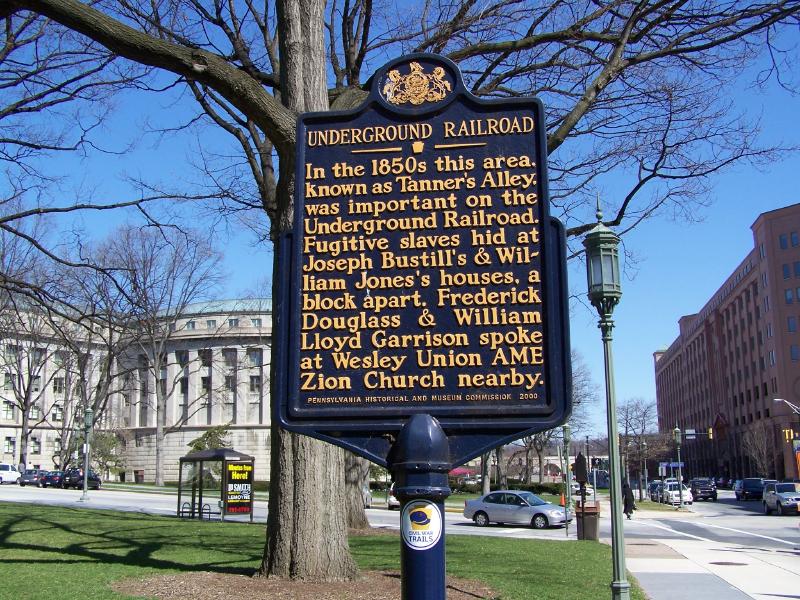
    <summary type="html"><![CDATA[<p><strong><em>Harrisburg, Pennsylvania connected southern states and western cities to larger hubs along the Underground Route railroad, making it the heart of the central route. Anti-slavery committees, abolitionists, and advocacy groups created pathways, safehouses, and resources for freedom seekers to travel northward towards independence.</em></strong></p><img src="https://harrisburghistorical.org/files/fullsize/7989c78a5857fb741d76fa00e73c13a3.jpg" alt="Underground Railroad Marker" /><br/><p>Harrisburg played a crucial role in the Underground Railroad. The city lay on the Central Route of the Northern Underground Railroad system due to its large Black population and long history as the capital city of a free state. Escape routes led to and from the city, creating four major exit routes for freedom seekers to travel. </p><p>A Pennsylvania state marker, located on Walnut Street near the Commonwealth Monument in the Pennsylvania State Capitol Complex, describes Harrisburg’s participation in the Underground Railroad. It identifies the roles of Wesley Union African Methodist Episcopal Church, Joseph Bustill, and William M. Jones in hiding and assisting freedom seekers. In the 1850s, the area connecting these individuals and institutions was known as Tanner’s Alley and numbered among the city’s most important Black neighborhoods. It is now recognized as a prominent location in Harrisburg’s Underground Railroad. </p><p>Wesley Union Church, the first Black church in Harrisburg, was founded in 1829. In 1836, the Harrisburg Fugitive Slavery Society, an informal society that sent freedom seekers to Philadelphia, began using the church and its influence among the Black community to promote abolition. Historical sources provide the names of a number of Harrisburg residents involved in the Underground Railroad. </p><p>One of these was Joseph Cassey Bustill, an African American schoolteacher who had been born in Philadelphia to a distinguished family. Joseph joined the Underground Railroad at age seventeen and was perhaps the youngest member of the movement. According to Bustill’s daughter, Bustill made use of homes, churches, halls, and lodging rooms to help the fugitives. Furthermore, he assisted in the formation of the Harrisburg Fugitive Slave Society, and often contacted William Still regarding the arrival of freedom seekers in Philadelphia, referring to them as “packages” nearing “delivery.” </p><p>Another was William “Pap” Jones, an African American doctor whose home served as the site of his medical practice and a refuge for freedom seekers. The Jones residence was one of the primary stations on the Underground Railroad in Harrisburg, where Dr. Jones and his wife, Mary, provided a safe space to rest and ample provisions for the journey ahead. Dr. Jones transported freedom seekers to their next station on the Underground Railroad via a covered wagon operating under the guise of a “rag merchant.” Through his extensive knowledge of the routes leading North and collaboration with fellow guides, Dr. Jones took many freedom seekers closer to safety.</p><p>Harriet McClintock Marshall, born in Harrisburg in 1840, was also a conductor on the Harrisburg Underground Railroad, most likely working through the Wesley Union AME Church founded by her mother. Harriet and her husband Elisha Marshall, a former freedom seeker, opened their home as a safe house and offered refuge, food, and clothing to those seeking freedom.</p><p>Harrisburg also connected freedom seekers to the Vigilant Committee of Philadelphia. The Vigilant Committee was formed by Robert Purvis in 1837 to “create a fund to aid [Black Americans] in distress.” It was responsible for helping many freedom seekers and their families. The committee appointed officers, raised money, and made resources available to assist freedom seekers attempting to live in or pass through Philadelphia on their way further north. Although the original committee was disbanded in 1852, another quickly took its place with Purvis as the head of the general committee. </p><p>The travels of the Taylor family, a notable family aided by these committee resources, exemplify how the network functioned. In 1856, Owen and Mary Ann Taylor and their family fled Clear Spring, Maryland, in a desperate attempt to claim freedom. Owen Taylor and his brothers had been enslaved by a farmer Henry Fiery, his son. The Taylor brothers harnessed horses belonging to Fiery, placed their families in the carriage, and headed north. The eight freedom seekers traveled eighty-seven miles from Clear Spring to Harrisburg, crossing the Pennsylvania-Maryland border, and traveling through Chambersburg, Pennsylvania. From there, the group made their way to Philadelphia, where the Vigilant Committee met them. </p><p>Henry Fiery quickly realized the Taylors were missing and contacted Joseph C. Bustill, who assured Fiery he would work to return the group. However, correspondence between Bustill and other Underground Railroad conductors reveals just the opposite. Bustill, despite being in contact with enslavers, actively worked against them and aided freedom seekers, directing them to safe spaces farther north. The remarkable story of Owen Taylor and his family for many such narratives in Harrisburg’s rich history of the Underground Railroad. </p><p>Despite Harrisburg’s historic presence of Black freedmen, the anti-slavery fight faced adversity during the 1850s. The Fugitive Slave Act (1850) required the return of people to their enslavers even if they were in a free state. The same year, a Slave Commission Office opened in Harrisburg. Richard McAllister, a local attorney and commissioner, was infamous for seizing Blacks, fugitives or free, and sending them to the slave market. McAllister had a notorious reputation. As the historian, R. J. M. Blackett noted, McAllister boasted that “more fugitives have been remanded by me than any other U.S. Com.” He asserted the Fugitive Slave Law should be kept to protect the “peace and interest of the country.” The next year, the congregation of St. Stephen’s Episcopal Church in Harrisburg gave McAllister an ultimatum: he could resign as commissioner or forfeit his position as Vestryman. McAllister chose the former and resigned as slave commissioner in 1852. By 1853, the Slave Commission Office ceased operations. After McAllister resigned, Harrisburg more freely aided countless freedom seekers on their journey north.</p><p>Harrisburg, Pennsylvania played a critical role for those seeking freedom for themselves and their families. There are many more stories of Harrisburg area residents who helped aid freedom seekers, including Henry Watson, Daniel Kaufmen, Jacob Shockley, Hiram E. Werz, James McCallister, Dr. William W. Rutherford of Front Street, and Reverend James Graham. Indeed, Harrisburg and its residents helped innumerable freedom seekers to safety. Their lives and the history of the city are forever intertwined in the fight against slavery, a time that represents a pivotal period in American history. </p><p>A full list of the resources used in this story can be found <a href="https://www.zotero.org/groups/5114087/harrisburg_historical/collections/I8I8SMVX">here</a>.</p><p><strong>Related Stories</p><a href="https://harrisburghistorical.org/items/show/3">Men of God</a></p><p><a href="https://harrisburghistorical.org/items/show/12">It's a Family Business</a></p><p><a href="https://harrisburghistorical.org/items/show/5">Douglass in Harrisburg</a></p><p><a href="https://harrisburghistorical.org/items/show/2">Harrisburg's Lincoln Cemetery</a></p><p><em><strong><a href="https://harrisburghistorical.org/items/show/8">For more (including 5 images&#32;&amp;&#32;2 audio files) view the original article</a></strong></em></p>]]></summary>
    <published>2024-02-12T20:25:46+00:00</published>
    <updated>2026-04-17T19:49:02+00:00</updated>
    <link rel="alternate" type="text/html" href="https://harrisburghistorical.org/items/show/8"/>
    <id>https://harrisburghistorical.org/items/show/8</id>
    <author>
      <name>Elizabeth Movinsky</name>
    </author>
  </entry>
</feed>