Hercules, Harris, and the Mulberry Tree
History and Memory in the Founding of Harrisburg

Among the folk tales recounting the early days of the settlement of Harrisburg, Pennsylvania, none is more dramatic than the story of Hercules rescuing John Harris, Sr. from almost certain death at a mulberry tree. Passed down by Harris’s descendants, the story positions Black individuals at the forefront of the capital area’s history and raises critical questions about the complex relationship between history, memory, and race.
Around 1720, a group of Native Americans allegedly approached the first European settler of Harrisburg, John Harris, Sr., at his settlement near the Susquehanna River, demanding rum. As later historical accounts would describe, Harris refused their request and the frustrated Native Americans tied him to a nearby mulberry tree to burn him alive. Just in time, Hercules, who was enslaved by Harris, led a different band of Native Americans to the rescue. Overwhelmed and grateful, Harris immediately released Hercules from slavery. Before he died in 1748, Harris insisted on being buried at the mulberry tree. Over generations, the people of Harrisburg would remember the names of John Harris and Hercules as they retold this narrative. Though the ultimate veracity of the incident is uncertain, and certain elements doubtful, it offers a compelling example of the intersection between memory and history—how events can, in the shared memories of a community, take on a life and power of their own, continuing to inspire, shape, and challenge a city's past.
In the retelling of John Harris’s and Hercules’s experience at the mulberry tree, John Harris’s leading figure captivated audiences. Born in 1673 in Yorkshire, England, he abandoned his profession as a brewer in London and arrived in America sometime before 1700. He first lived in Philadelphia, where he met his wife, Esther Say, and later moved to the lower bank of the Susquehanna River in what is today Harrisburg’s Riverfront Park. In 1705, Harris began trading with the Native Americans and furthered his success in agriculture.
Hercules’s role in the story has usually been small in comparison, and his person shrouded in memory. That Hercules was a real man, initially enslaved and later freed by John Harris, Sr., is clear, although "Hercules" cannot have been his original name, but one given to him by his white enslaver after his daring deed of rescue. Key details about Hercules's life and death, such as his location of burial, remain elusive. An 1858 piece from the Harrisburg Daily Telegraph implies that Hercules was first buried at a small graveyard that the Harris family owned, and by 1785, had been moved to another gravesite created specifically for African Americans. The cemetery was disturbed in the 1850s and was then moved to Harrisburg Cemetery on Allison Hill. Hercules’s burial site, therefore, is long lost and unknown.
The same mystery about Hercules’s whereabouts also surrounds the mulberry tree incident. Inconsistencies between Harris's descendants' accounts and a lack of recorded evidence fuel the uncertainty surrounding the narrative’s historicity. The location of the incident is unverified, although a long tradition has placed it at the Harris Burial Ground in Riverfront Park. The date of the mulberry tree incident is also uncertain.
Even the core details of the story raise questions. The presence of drunken Native Americans, for example, reflects a familiar stereotype of Indigenous peoples of colonial times. The conflict Harris had with them, if true, was probably more complex than a dispute over rum. The publication of the story in the late 1820s, a century after the incident, also raises questions about the role of Hercules, because it appeared at a time of growing abolitionism in the Commonwealth that favored stories of obedient and virtuous slaves.
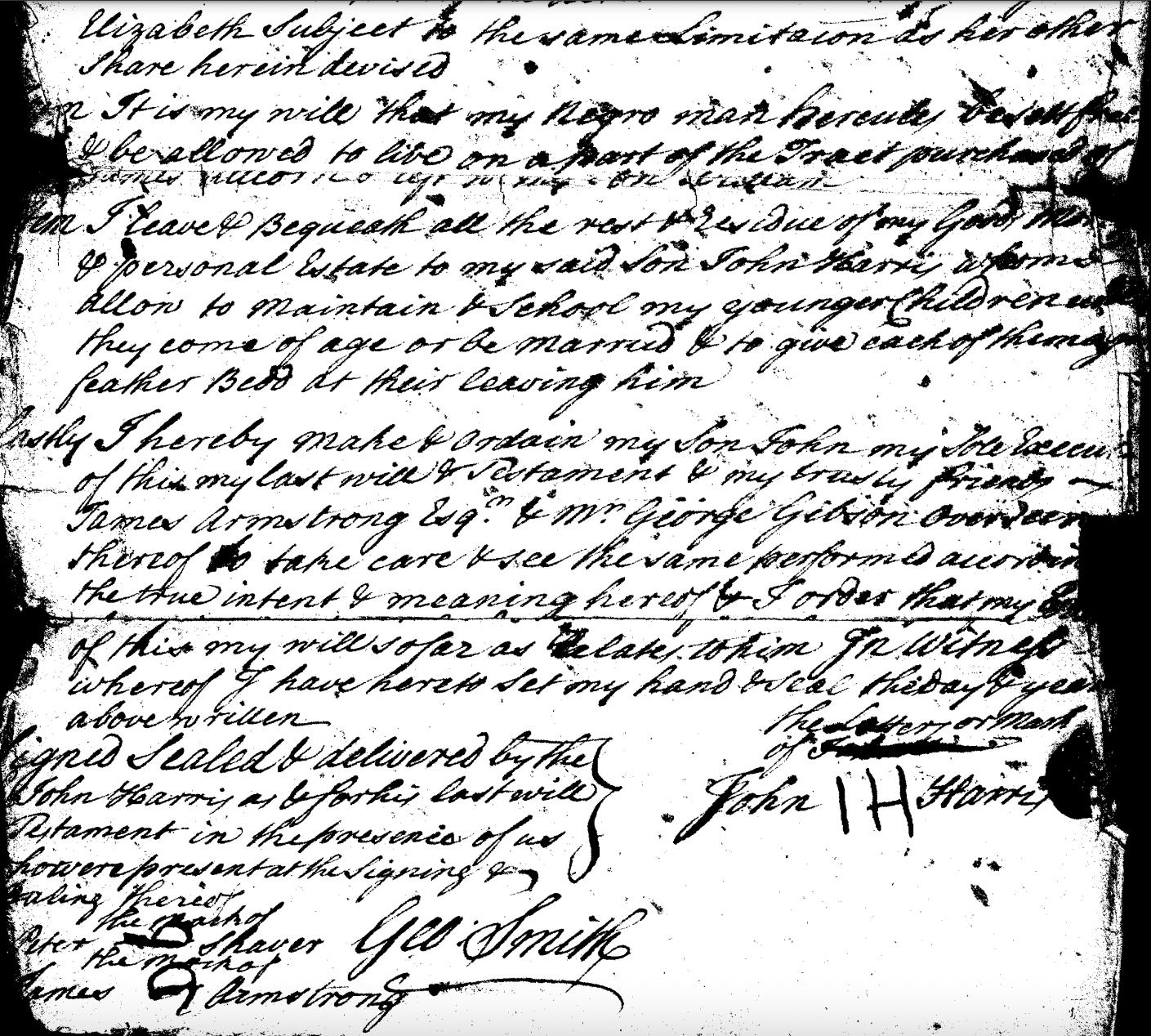
On the other hand, certain details surrounding Hercules suggest that he did in fact do something significant for John Harris, Sr. Aside from his heroized name, we find credible evidence regarding Hercules's life in Harris's will of 1746, which details the distribution of his land and property between his sons John, William, Samuel, and David; his daughters Elizabeth and Esther; and his wife, Esther. Harris would “leave” two enslaved people, Tom and Cherida, with his children, but instructed that Hercules be “sett free” and “allowed to live on part of the land . . . left to my son William.”
Additionally, an account published by the Harrisburg Telegraph in 1900 purports to transcribe account books of John Harris, Jr., founder of Harrisburg, and notes specific instances of Hercules working for John Harris, Jr., for a year in 1754; receiving supplies (powder, shott, and hooks) in 1761; and gaining cash payment in 1773. The evident emancipation of Hercules, and continued enslavement of Cherida and Tom, may point to a significant event through which Hercules earned Harris's assent to freedom.
In the nineteenth century, however, Harris’s descendants were unable to provide credible evidence of Hercules's participation in the mulberry tree incident, which contributed to various interpretations and embellishments of the tale by Harrisburg’s authors.
In 1828, when author Samuel Breck first published an account of the incident as told by Robert Harris, great-great-grandson of John Harris Sr., Hercules was Harris’s rescuer. Contrarily, a letter by Robert Harris’s son, George Harris, published in the Harrisburg Telegraph in 1878, claimed that Robert Harris did not actually believe that Hercules saved John Harris. However, George Harris himself believed that Hercules was well-deserving of the credit and that his father's opinion may have been faulty.
If even the family members were divided, it is no surprise that some authors discounted Hercules altogether, while others praised him. George Morgan, for example, echoed Breck’s description in his Annals of Harrisburg (1858), conveying the narrative as a part of the Harris family’s traditional history that should be trusted. Hercules, Morgan wrote, was “virtuous” and should “share largely in our praise and admiration.” Similarly, William Egle emphasized in his History of the County of Dauphin (1883) that this narrative, including Hercules’s role, was based on accurate resources and “was no myth.” Other authors embellished the story with differing emphases, such as Marian Inglewood (1925), who described Hercules's involvement as a timely rescue, rather than a brave, faithful act.
The narrative also captivated artists. A woodcut by G. Gilbert dating to the 1840s, for example, shows Hercules leading a friendly band of Native Americans to rescue Harris from his intoxicated captors. William S. Reeder’s painting, "The Attempt to Burn John Harris," lithographed by Ralph Trembly around 1839, became a representative image of the mulberry tree incident with Harris and Hercules. Its origin and creation date are not certain, but George Harris revealed that his father, Robert Harris, and Reeder closely communicated about this painting. In 1895, Robert Harris said in a column in The Harrisburg Telegraph that Reeder’s painting originally depicted a Native American as Harris’s rescuer. Only later was it recreated to represent an African American figure, Hercules, rescuing Harris.
While Hercules’s complete identity remains a mystery, his figure reflects Pennsylvania’s wider colonial history of enslavement and abolitionism. Though slavery had a comparatively small presence in the colony—the institution peaking at six thousand in 1750—Pennsylvania, like other colonies, introduced slave codes that restricted enslaved people's movement and conduct. Abolitionist efforts to end slavery in the colony culminated in 1780 with "An Act of the Gradual Abolition of Slavery," which mandated that all enslaved persons born after its passing would gain freedom upon turning age twenty-eight.
Aside from Hercules, John Harris owned two other individuals, whom we know as Tom and Cherida. At the time of Harris’s written will, Cherida was pregnant with a child. Hercules’s role, then, in the fascinating tale of John Harris’s rescue at the mulberry tree is significant in such a period of growing stratification between enslaved African Americans and their white enslavers.
The story of the mulberry tree is a marked event in Harrisburg’s early history, introducing a fascinatingly dramatic tale of Harrisburg’s first European settler, Indigenous tribes, and an otherwise obscure African American named Hercules. Though records of Hercules's life remain sparse, his role in early Pennsylvania history stands out as one of the first documented instances in which an African American emerged as a central figure in Harrisburg's colonial narrative, challenging the typical erasure of Black voices from this era. While we may never find a resolution to the events at the mulberry tree or confirm Hercules's role, the dramatic yet evasive event continues to enrapture Harrisburg and capture our memory with awe and mystery.
A full list of resources used in this story can be found here.
Audio
Images