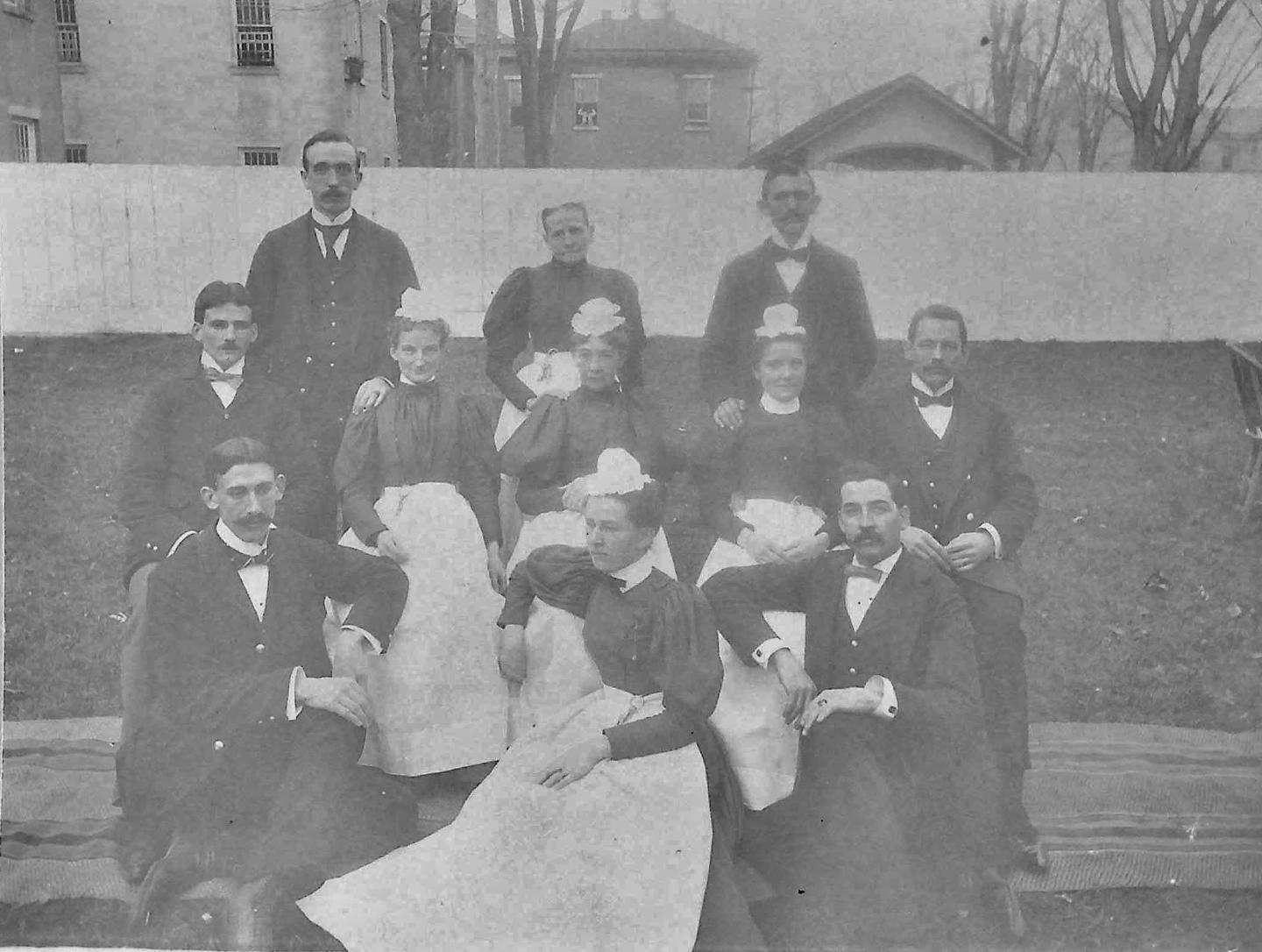
In 1950, the prominent Maude Coleman, Interracial Consultant for the Commonwealth of Pennsylvania, wrote a letter to Governor James Henderson Duff advocating for the rights of Black homeowners of the Seventh Ward. In it, Coleman continued her fight to combat the state's seizure of property in her neighborhood.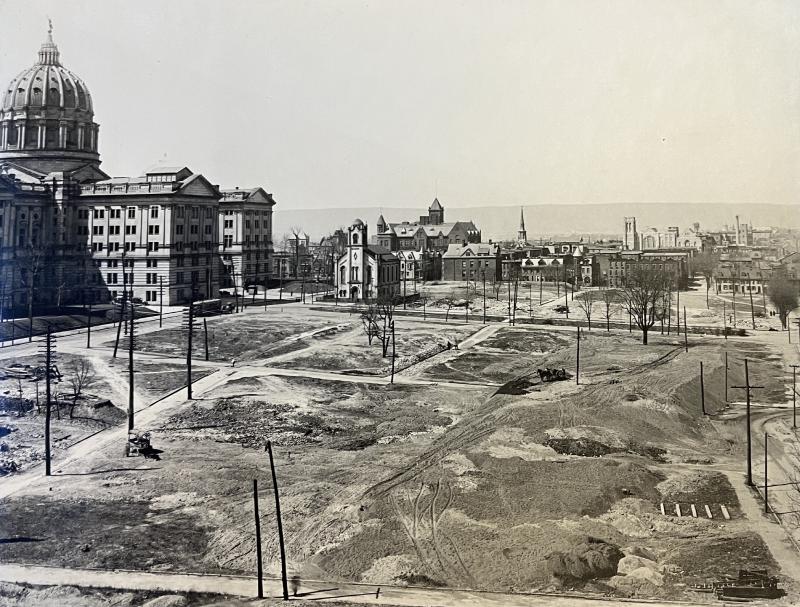
In the first half of the twentieth century, during a time of radical change and social upheaval following the Reconstruction period, urban African American communities found themselves at a crossroads of uncertainty. The multiethnic neighborhoods east and northeast of the Pennsylvania State Capitol Building had faced similar circumstances through the First and Second Capitol Extension Projects carried out by the State legislature between the 1910s and 1950s. Those living in these neighborhoods did not capitulate without a fight, with one individual in particular, a community organizer named Maude Coleman, publicly writing to the state governor to affirm the value of her home and those of her neighbors. The letter to the Second Capitol Extension project renewed awareness of the unjust seizure of property in the diverse communities within the City of Harrisburg.
The appropriation of neighborhoods for the construction of Pennsylvania government buildings took place during multiple decades, beginning in the early twentieth century. North Street formed the divider between the destruction of properties in the "First Capitol Extension" and the "Second Capitol Extension." The first extension was passed by an act of the Pennsylvania Assembly in 1911 and claimed the section of the Old Eighth Ward defined by today's Walnut Street, Seventh Street, North Street, and Commonwealth Avenue. The Capitol Park Extension Commission invested thirty-six million dollars post-1913 to demolish twenty-nine acres (and 538 buildings) east of the Capitol building to create new state government buildings and recreational land by the early 1930s. In 1941, the Capitol Grounds Extension Planning Committee led by J. Horace McFarland outlined a proposal for a second extension and the acquisition of twenty-three more acres between North Street and Forster Street, from Third to Seventh Street across the northeastern corner of the Fourth Ward, and most of what remained of the Old Eighth Ward. This area contained 334 properties with 176 specific owners and a sizable residential population, of whom 50 percent were African Americans. Further extensions in the 1950s claimed neighborhoods north of Forster Street in the southern part of Harrisburg's Seventh Ward.
It was not uncommon for local, state, or federal officials to factor in race for urban planning efforts during the early to mid-twentieth century. Often, city planners applied generalized stereotypes of poor living conditions in diverse communities to accomplish their goals. In the case of the communities outlined for the initial phase of the Second Extension, the 1935–1936 Home Owners’ Loan Corporation survey noted that the homes between Third and Sixth Street possessed “considerable new paint and good exteriors” as opposed to remaining sections of the Old Eighth Ward to the east which was “run down [and] neglected” and was occupied by “alien white, negroes, and less desirable native whites.” In the planning report, these supposedly run-down homes were labeled as fire hazards (27 percent), with around 30 percent having outdoor plumbing. The planners also outlined other reasons to justify why the location should be purchased, including the improvement and widening of roads to ease traffic and to replace substandard buildings with favorable land for future construction projects.
The report prepared by the Capitol Grounds Extension Planning Committee was expansive, covering the usability of the extension area; the status and quality of its buildings and owners; the cost factors relating to how properties were to be acquired; the ways in which their project was to be financed; external legal aspects, the block plan; and a seven-step list of ways the extension area was to be further developed. Even still, the document does not offer any specific evidence regarding the social, cultural, or genealogical characteristics of those who lived in the second extension properties. There is, however, a blueprint of the area with a corresponding list of all the property owners as of 1930 (see Plan of Properties, below).
The Second Capitol Extension began in early 1942, one year after the report’s publication and twelve years after the 1930 property assessment blueprint. During the next decade, the Pennsylvania government seized properties in the designated area north of the Capitol Complex, but also expanded well beyond the originally planned district into the neighborhood of the Seventh Ward north of Forster Street. When Maude Coleman received a notice that the Capitol Park Extension planned to confiscate houses on her own block to create office space for the Department of Labor and Industry, she shared her feelings with then-Pennsylvania Governor James Duff.
Coleman was born in 1879 and lived briefly in the Old Eighth Ward until the First Capitol Extension claimed her property in 1912. Later, Coleman lived on Boas Street in the Seventh Ward from 1920 to 1953. On February 20, 1950, Coleman sent a letter to Governor Duff on behalf of a friend. Coleman was familiar enough with Pennsylvania's governors because of her intermittent service as Interracial Consultant from 1924 to 1953. Coleman used her professional capacity to appeal to Duff on behalf of the predominantly African American community located in and around the Second Extension area. While not located in the area initially proposed in the 1930 report, her neighborhood on Boas Street lay just one block north of Forster Street and marked the target for new appropriations in the 1950s. Coleman’s letter to Duff argued that the conditions for African Americans to acquire (new) housing in Harrisburg were “absolutely impossible” due to unwritten restrictions within the city. Additionally, Coleman pointed out that the homes in the extension area were not slum houses as the Planning Commission labeled them. Some of the occupants of this neighborhood included “ . . . our only Negro druggist in Central Pennsylvania, a practicing physician, a mortician, the best tourist home for Negroes in the city, and State and city employees.” In her view, they numbered "among the best homes for Negroes in Harrisburg."
Maude Coleman’s plea for consideration was ignored. In the end, Coleman's home met the same fate as 500 other properties of the Fourth, Seventh, and Eighth wards removed during the execution of the First and Second Capitol Extensions. Coleman's house at 641 Boas Street became the parking lot north of the Pennsylvania Labor and Industry Building where, ironically, stands the Pennsylvania Worker Statue today — a sculpture designed to honor the state's working population. The construction of office buildings, parkland, the Pennsylvania State Museum, and the former site of the Pennsylvania State Archives has shrouded the histories of hundreds of residential properties like that of Maude Coleman beneath the administrative facilities of the state.
A full list of the resources used in this story can be found here.
Related Stories
The Phyllis Wheatley YWCAA Gathering at the Crossroads
Black Politics and City Beautiful
Green Book Harrisburg
For more (including 5 images & 2 audio files) view the original article
]]>