More advantages should be procured for the further advancement of our children in knowledge, so as to fit them to occupy the various positions that are every day opening to our people, and not only that, but to sufficiently qualify them for the business pursuits of life.
— William Howard Day, speech quoted in the Harrisburg Telegraph, Dec. 11, 1874In early-nineteenth-century Harrisburg, Black children had limited access to formal education. The public school system was segregated and the provision of classroom spaces fell upon Black churches. In 1817, the Wesley Union Zion African Methodist Episcopal church-run Franklin Hall opened its doors to pupils. Such church schools served as Black Americans’ primary form of access to education until after the Civil War. Some Black students enrolled in the Lancasterian School on Walnut Street, founded in 1827. The school provided free education to a racially diverse group of students until the city closed it in 1834 on the grounds that it was not sufficiently profitable. Harrisburg’s “first integrated school” was then replaced by the all-white DeWitt School for Boys.
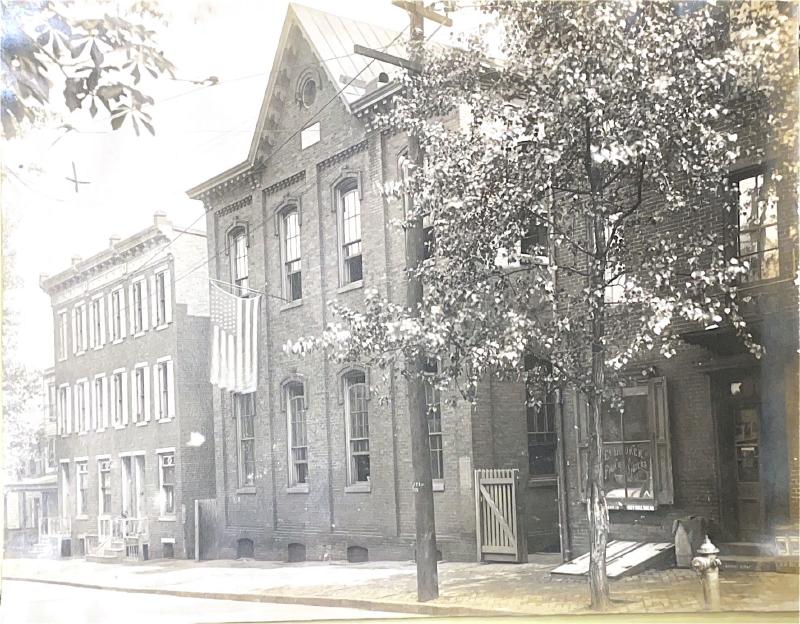
One approach to addressing the educational inequity in Harrisburg was to establish schools specifically for the Black population. Under the guidance of State Superintendent of Public Instruction James P. Wickersham, Harrisburg constructed several schools in majority-Black neighborhoods in the Sixth and Eighth Wards. One such institution was the Lincoln School, which opened at the corner of North and Fifth Streets in 1871. Led by Principal Spencer P. Irvin, the Lincoln School was widely known for its robust extracurricular offerings, including Christmas festivals, musical ensembles, and skilled athletics teams.
As much a testament to racially restrictive policy as to progress, the Lincoln School suffered from Harrisburg’s unwillingness to prioritize funding for Black institutions. While white schools received grants to expand their buildings and upgrade equipment, the Lincoln School went decades without receiving finances for renovations. Parents protested the injustice, noting how their children and teachers frequently contracted illness from the poorly ventilated rooms. Something more needed to be done.
Major strides in educational reform for Harrisburg’s Black population were made under the leadership of one of the most celebrated civil rights leaders of the era: Reverend William Howard Day. Originally from New York City, Day was an activist and orator who spoke out against slavery and, later, the subjugation of Black Americans in the United States. He also served as the Superintendent of Colored Schools in Maryland and Delaware in the late 1860s. Day arrived in Harrisburg in 1871 to work as the secretary for the auditor general-elect, but in 1874, he became directly involved in Harrisburg’s education system when he was appointed to the Pennsylvania Department of Education Board of Examiners. He held numerous other offices, serving as the first African American member of the Harrisburg School Board in 1878 and, in 1891, rising to become its president. At the time, he was the only Black school board president in the nation. While in office, Day oversaw the enhancement of schools for all children in Harrisburg, but was especially committed to improving the quality of education for the city’s Black students.
Recognizing the disparity between resources provided to white and Black schools, Day advocated tirelessly for the desegregation of Harrisburg’s education system. He called for the “abolition of white schools,” acknowledging that this was the surest path to ensure equitable access to resources for both Black and white students. Day also successfully decreased truancy rates across the city by implementing a more effective attendance system and allocated city funds toward the purchase of textbooks for all schools, including the majority-Black institutions.
Day also served as a mentor to Black students, encouraging them to own their education and pursue excellence. In the late 1870s, he advocated for two Black students at the Lincoln School, John P. Scott and William H. Marshall, to be admitted to the all-white Boys' High School. After excelling on their entrance exams, Scott and Marshall were the first Black students enrolled at the Boys' School in 1878. That same year, two African American girls, whose names have been lost to history, were the first to be admitted to the Girls’ School. These four students marked the first major victory of a century-long battle to integrate Harrisburg’s schools. When they graduated in 1883, both Scott and Marshall read commencement addresses. Scott pursued a career as an educator, remaining in the Harrisburg school system for forty-seven years. He ultimately returned to the Lincoln School as principal and, working alongside Day, helped establish a new library for its students.
The reforms of the 1870s and 80s were not the final strides of the education justice movement but its first steps. William Howard Day, John P. Scott, and their contemporaries helped bring the call for educational reform to the center stage of Harrisburg politics amid continued resistance from white residents. It would be their twentieth-century successors who picked up the mantle, and the students of the 1970s who would see the full realization of the dream for integrated schools. As for the Lincoln School, it was renamed the Day School in 1903, memorializing its friend and strongest supporter, William Howard Day. In 2020, Harrisburg unveiled a bronze statue of Day as part of the monument group called "A Gathering at the Crossroads" — a fitting reminder and celebration of the orator's legacy of change.
A full list of the resources used in this story can be found here.
Related Stories
Men of GodFor more (including 4 images & 2 audio files) view the original article
]]>