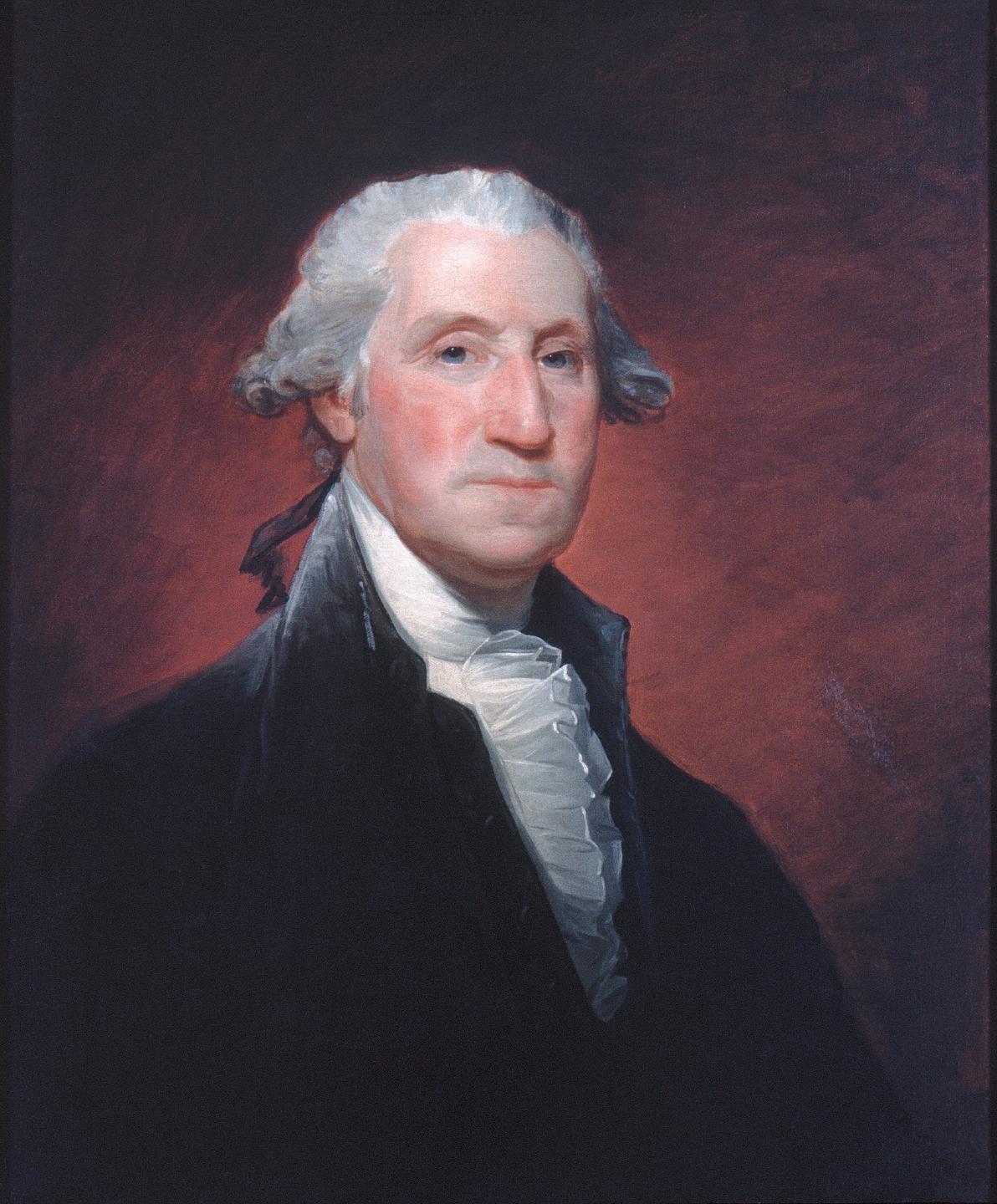
The newly formed United States, still celebrating its independence from Britain, faced heavy war debts. To pay off these debts, the government imposed a tax on the distillation of whiskey. Opposition to the tax was especially potent in western Pennsylvania, where the production of whiskey from surplus grain formed an important part of farmers’ livelihoods. In 1794, spurred by continued violence towards tax collectors and fears of open rebellion against the federal government, President Washington raised a large militia force to suppress the conflict and assert the new government’s authority. On his way out west, he stopped briefly in Harrisburg and recorded his observations about the Susquehanna River and the nascent town.
Washington arrived in Harrisburg on October 3, 1794. He traveled with notable figures such as Secretary of War Henry Knox, Secretary of the Treasury Alexander Hamilton, District Court Judge Richard Peters, and his secretary, Mr. Dandridge. The president met the First Regiment of New Jersey, which had arrived in Harrisburg earlier that morning in a rainstorm and consisted of about 560 men. According to David Ford, a captain in the regiment, Washington had intended to cross the Susquehanna that day because he feared the past two days of heavy rain would make crossing in the morning difficult. After some residents assured him the rain would not affect the river, he and his troops stayed overnight. Rather than pitch their tents, they relied on local hospitality, with some residents taking in upwards of twenty men.
Washington stayed in a log building on a site located now on the southeast corner of Second and Market Streets in Market Square. After dinner, he went for a walk, describing the young town, only nine years old, as “considerable for its age.” Captain Ford detailed what Washington would have seen at the time, saying Harrisburg consisted “of about 300 houses, 2 markets, court house and other public buildings, 3 churches, a number of very genteel well built brick houses.” Washington also noted in his diary the abundance of fish in the Susquehanna, describing rockfish over a foot long and salmon swimming in the water.
The citizens of Harrisburg had an overwhelmingly favorable opinion of Washington. A Philadelphia Gazette article from October 6, 1794, states that, “The pleasure excited, in beholding, for the first time, our beloved chief, in this borough, is not easily described.” Two burgesses, Conrad Bombach and Alex Berryhill, delivered an address to Washington on behalf of the city of Harrisburg. They expressed both joy at seeing Washington in their town and concern over the unrest caused by the Whiskey Rebellion. Their address affirms their trust that virtuous, peaceful citizens will prevail and the rebellion will not. They also show complete faith and trust in Washington to quell the conflict.
Washington responded with a gracious message of his own, which was published, alongside the burgesses’ statement, in the Philadelphia Gazette. He affirmed the patriotism of Harrisburg’s residents and thanked them for their support, describing his mission to end the unrest as a “defense of the laws.” Washington made plain that the Whiskey Rebellion threatened the new Constitution and that his success in quelling it would “serve to confirm the blessings of peace we enjoy, under a constitution that well deserves the confidence, attachment and support of virtuous men.” Such men, he continued, included the inhabitants of Harrisburg.
Washington departed Harrisburg the next day, on October 4. At daybreak on a chilly morning, the army began fording the Susquehanna’s cold, shallow waters. Major William Gould recorded how the men “suffered much with the cold in crossing.” Gould also noted that Washington crossed the river in a carriage, which the president drove himself. Washington then continued westward, reaching Carlisle early in the afternoon, ending his first and only stay in Harrisburg.
To commemorate the first president’s visit, Harrisburg residents christened the log building where Washington spent the night as the Washington Inn. The site of the Washington Inn would go on to have a long history in the city. It eventually became the location for the Jones House, a hotel that, sixty-seven years after Washington, President Abraham Lincoln stopped at on February 22, 1861, on his way to his inauguration. Although he intended to stay the night at the Jones House, his team caught wind of a plot to assassinate him in Baltimore, leading them to arrange for a secret train to carry the reluctant president directly to Washington, D.C. The Jones House later became the Commonwealth Hotel, and then the Dauphin Building, owned by the former Dauphin Deposit Bank. That building was demolished in 1990 to make way for the Bank’s new headquarters, now known as the Allfirst Tower. But the Washington Inn, and later the Jones House, will forever be part of Harrisburg’s history as the site of a visit from two of the country’s most consequential presidents.
A full list of the resources used in this story can be found here.
]]>